
Do I Need a Hip Replacement?
How to tell whether it is time for a hip replacement — the socks-and-shoes test, why groin pain matters more than the X-ray, whether you are too young, and what the operation can and cannot deliver.

Nothing measures this for you.
There is no scan finding, no blood result and no birthday that makes a hip replacement necessary. It is an operation you choose, at the point where what the arthritis is taking from you outweighs surgery and a few months of getting over it. Which makes it an unusual sort of medical decision, and one that belongs to you rather than to an X-ray.
Below: what genuinely signals that the time has come, what merely looks like it does, and what the operation is and is not able to give you.
First, are we sure it is the hip?
Worth settling before anything else, because a fair number of people spend months treating the wrong thing.
The joint sits deep in the groin. Not on the outer side, which is where practically everyone points when you ask them to show you their hip. Groin pain that builds the longer you are on your feet is the pattern that matters.
Two things follow from that, and both come up most weeks in clinic.
- An arthritic hip often sends its pain to the knee. The two joints share a nerve supply, so the ache travels down the front of the thigh and settles somewhere around the knee. People turn up wanting something done about a knee that is, on examination, perfectly fine.
- Pain on the bony point at the side of your hip is usually not the joint at all. That is more often the tendons and the bursa lying over them — gluteal tendinopathy or trochanteric bursitis. Different problem, different treatment, and no amount of replacing the joint will touch it.
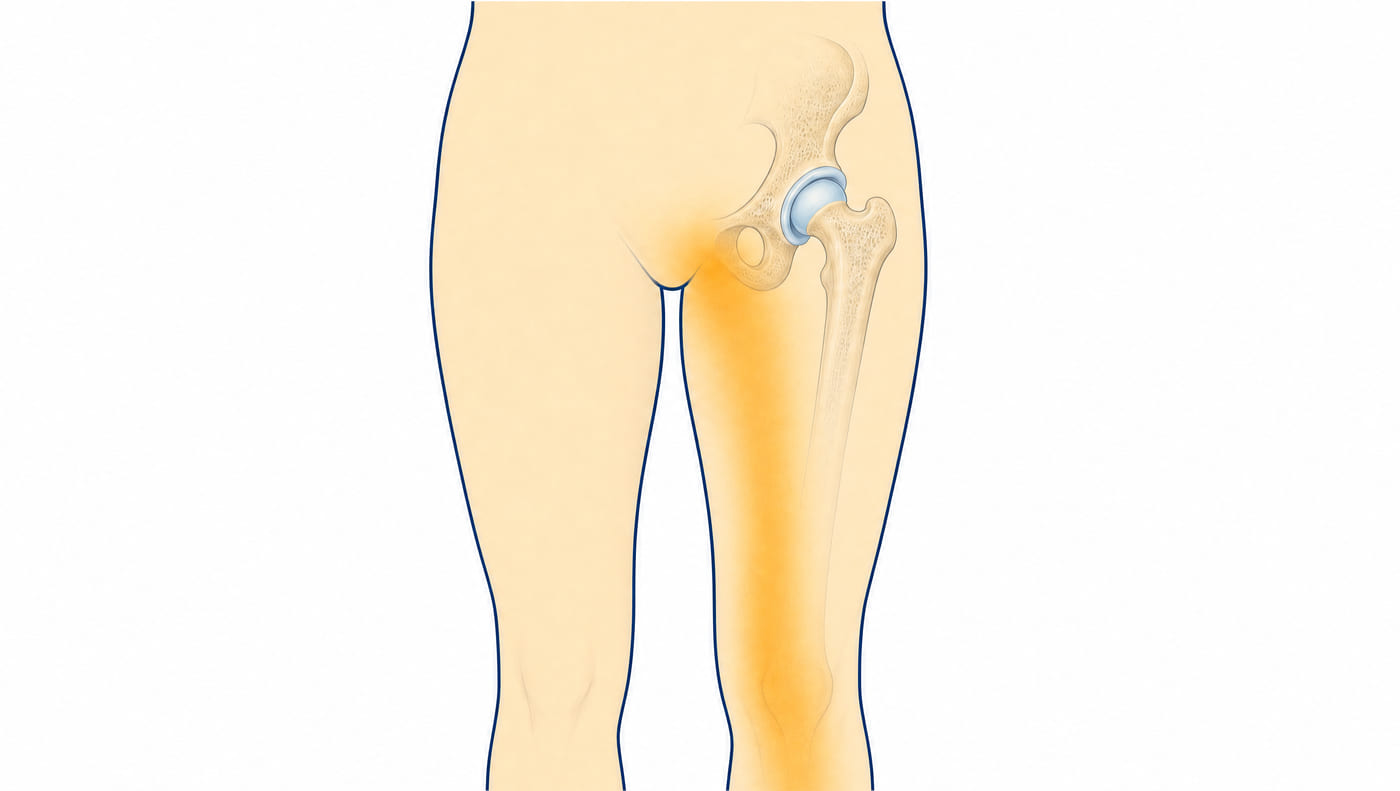
Groin, and worse under load? Read on. Sore on the outer side and painful to lie on? The page linked above is the one you want.
The X-ray tells you less than you think
Nearly everyone arrives having been told their hip is “bone on bone”, and hears it as a sentence being passed.
It is a caption for a photograph. Some people carry dreadful-looking hip films around a golf course twice a week. Others are barely leaving the house on images a radiologist would call moderate.
What the film is genuinely good for is confirming the arthritis, showing its pattern, and letting an operation be planned properly — implant size, position, leg length. What it cannot do — and this is the part that gets lost — is tell you whether you want that operation.
The socks and shoes test
If you take one question away from this page, take this one.
Can you still reach your own foot without a production being made of it? Sock on, shoe done up, toenails cut, on the side that hurts.
Hip arthritis comes for your rotation first, well before it touches your walking distance, and reaching your own foot is the everyday job that rotation exists for. The adaptation happens so gradually that most people have not registered making it. They sit down to dress now. They hook the sock on with the other foot. And the toenails — this one comes up constantly — quietly became somebody else’s department eighteen months ago.
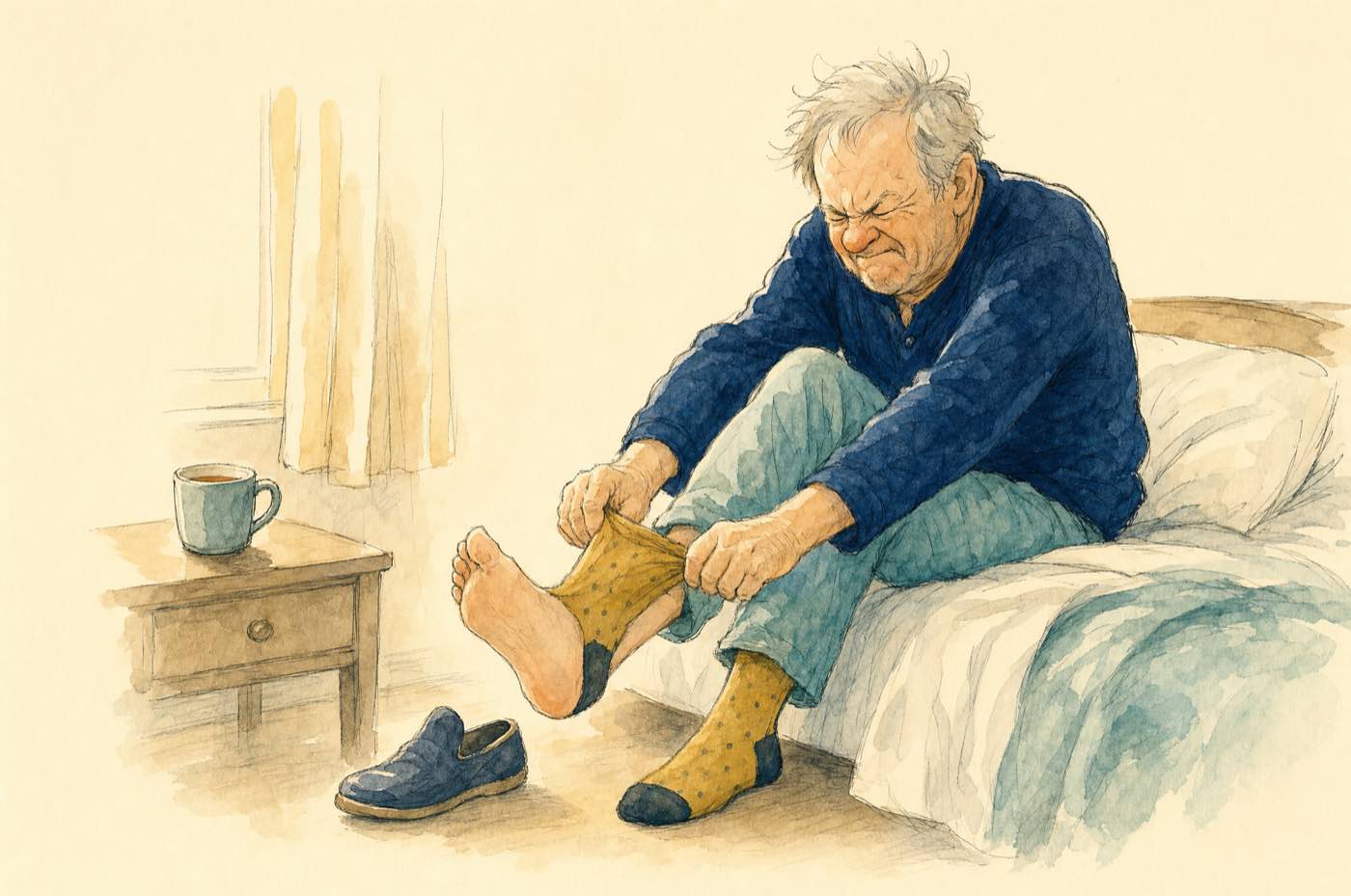
When that goes, the arthritis has usually been advanced for a while. Worth noticing, because the hip has been saying so for longer than you think.
Four questions to be honest about
These are the ones a surgeon will work through with you anyway.
Is it taking things away from you? Not whether it hurts — arthritic hips hurt. Whether it has started subtracting: work, sleep, walks, travel, the golf, getting in and out of the car without a strategy.
Does it wake you? Night pain, and shuffling around trying to find a position that holds, tends to mean the arthritis has moved past what conservative treatment handles well.
Has your range shrunk? Not your hip’s range — yours. The shops you have stopped going to, the car parks you now assess before committing, the long way round you no longer take. Ask whoever lives with you. They will have clocked it before you did.

Have you actually exhausted the alternatives? Not “I tried a few things”. Has a serious run at strengthening, load management and, where relevant, weight stopped paying you back? A hip that has never had those done properly still has options on the table.
Mostly yes, and it is reasonable to have the conversation. Mostly no, and it probably is not time — which is a fortunate position, not a wasted appointment.
Probably not yet
- Bad spells come and go, and the good weeks still win
- It flares with particular activities and settles down again with rest
- Reaching your foot is still unremarkable
- Strengthening and load management have not had a proper go
- What is driving the question is a scan result rather than your week
- Ordinary painkillers or an anti-inflammatory still make a real difference
None of that means never. It means an operation now would trade a problem you are managing for a recovery you do not yet need.
Possibly time
- Groin pain on most days, largely regardless of what you do
- Waking at night, or unable to lie on that side at all
- Shoes, socks and toenails have become a genuine production
- Walking distance down, and still going
- A limp that other people have started mentioning
- A stick you did not need this time last year
- The leg turning outwards, or your stride visibly shortening
- Your life is now arranged around the hip rather than the reverse
”Am I too young?”
This one costs people more unnecessary years than almost anything else in the field.
The instinct to wait dates from implants that did not last as long as today’s. Around 90% of hip replacements are still in place and working well at eighteen years, and modern ones are generally expected to run fifteen to twenty or beyond. Younger patients are revised more often — partly the arithmetic of living longer beside an implant, partly that they ask more of it. If one does eventually need attention, hip revision surgery is routine work rather than a catastrophe.
None of which is really the question. The question is what the waiting costs: a decade of declining invitations, while the muscle wastes and the good hip, the knees and the back quietly absorb the difference. Sometimes that is still the better trade. Often it is not, and nobody has framed it to you that way.
If you are in your fifties and have been told to come back later, ask what the reason is. There may be a good one. It should not simply be your date of birth.
Does waiting cost anything?
There is no cliff, and nobody should be hustled into this.
But it is not free either. Muscle lost to inactivity has to be rebuilt afterwards, which lengthens the recovery. The other leg and the lower back take up what the hip stops doing, and start putting in complaints of their own. And a hip that gets very stiff, or where the bone stock deteriorates, makes for a more demanding operation and a less predictable result than the same hip would have offered a year earlier.
Neither as early as possible nor as late as you can bear. The sensible point is where the symptoms reliably outrun what anything short of surgery can offer. Hip arthritis goes into the condition and the alternatives in more depth.
What it does and does not do
Reliably. Takes the arthritic pain away, for most people substantially. Gives back walking and rotation — the socks generally return. Sorts out the limp, once you have retrained the walk. More than 90% of patients get significant pain relief, and it sits among the top five elective operations for what it does to quality of life.
Less reliably. A patch of numbness or odd sensation near the scar is common, particularly with an anterior approach, and a small area sometimes stays. Some people get clicks, or a hip that never feels entirely like the original. Small leg length differences happen and are usually dealt with by a shoe insert if they are noticeable at all. And the timeline is longer than most people are told — back to normal activities inside six weeks for many, but the full thing runs six to twelve months.
The satisfaction figure. Somewhere around 90 to 95% of patients say they are pleased with the result. That is a striking number for elective surgery, and noticeably better than the equivalent figure for knee replacement — which is a large part of why hip replacement has the reputation it has.
A new hip is a very good hip. It is not the one you had at nineteen. People who go in expecting the former are, almost without exception, glad they did it.
Coming in does not commit you to anything
An appointment is an assessment and a conversation. It is not a booking.

It happens all the time that a hip turns out not to be ready and the patient leaves with a plan that involves no surgery whatsoever. A surgeon willing to say “not yet” is handing you better information than one who books everybody who sits down.
What you should walk out with is a clear account of what the joint is doing, what your realistic options are today, and what would have to change for that to change. Worth having, whatever you then do with it.
Where to go next
Not yet: Understanding Hip Arthritis explains the condition in plain English and what non-surgical treatment involves.
Possibly: Total hip replacement covers the operation, anterior hip replacement explains the approach Dr Clark generally prefers and what it changes, hip replacement recovery walks through the months afterwards, and what it costs sets out the public, private and self-funded routes.
Want a second view first? Second opinions are welcome, and commit you to nothing.
To talk it over, book a consultation, phone the rooms on (08) 6332 6365 or email info@rhysclark.com.au. Dr Clark consults at Murdoch and Mandurah.
How do I know if I need a hip replacement?+
Nothing measures it for you. Hip replacement is chosen rather than prescribed, at the point where what the arthritis is costing you outweighs an operation and a few months of recovery. In practice four things tell you where you sit: whether groin pain has started removing things from your life, whether it wakes you, whether you can still reach your own foot to put a sock on, and whether exercise and load management have stopped giving you anything back. Mostly yes means the conversation is worth having. Mostly no means it probably is not time.
What is the socks and shoes test for hip arthritis?+
Whether you can still comfortably reach your own foot to put on a sock, a shoe or cut your toenails. Hip arthritis takes rotation away before it takes anything else, and reaching the foot on the affected side is the everyday task that depends on it. Losing that is one of the more reliable practical markers that arthritis has become advanced, and it is a question worth asking yourself honestly.
Does bone on bone mean I need a hip replacement?+
No. It describes an X-ray, not a decision. Plenty of people have advanced-looking films and manage well, and some have severe pain with films that look comparatively mild. The X-ray confirms arthritis is present, shows the pattern, and helps plan an operation. What determines whether you need one is what the hip is doing to your life.
Am I too young for a hip replacement?+
Rarely on its own, though it does change the sums. Around 90% of hip replacements are still in place and working well at 18 years. Younger patients are revised more often, partly because they live longer alongside the implant and partly because they demand more of it. But the comparison people forget to make is with the alternative: a decade of stepping around things that matter to you, while the muscle wastes and the other joints pick up the slack. That is not automatically the safer bet, and it deserves to be weighed rather than assumed.
Is hip arthritis pain always in the hip?+
No, and this catches people out constantly. The hip joint sits deep in the groin, so that is where the pain is usually felt. It also refers down the front of the thigh to the knee, because the two joints share nerve supply — some people arrive convinced the problem is their knee. Pain on the bony outer side of the hip is usually the tendons or bursa there instead, which is a different problem with different treatment.
Will a hip replacement get rid of all my pain?+
Usually most of it. More than 90% of patients achieve significant pain relief and around 90 to 95% report being satisfied with the outcome, which places hip replacement among the more reliable operations in medicine. It is not a nineteen-year-old hip, and a patch of altered sensation near the scar or occasional aching after a long day is common. But as elective operations go, the odds here are good.
Does seeing a surgeon mean I have to have surgery?+
No. You are coming in for an opinion, and an opinion is all you are obliged to leave with. Plenty of people are told their hip has not reached the point where replacing it makes sense, and go home with something to do instead. Even then the appointment has earned itself — you now know what is actually going on in the joint and what would change the answer, which beats guessing.