
Both Knees: Together or One at a Time?
When both knees need replacing — the case for doing them under one anaesthetic, the case for staging them months apart, what the risks actually differ by, what the first fortnight is like with two new knees, and how the decision is made. Assessment with Dr Rhys Clark at Murdoch and Mandurah.
Plenty of people arrive with two arthritic knees. The question that follows is a fair one, and it is asked at almost every consultation where both are involved: do we do them together, or one at a time?
There is a real answer, and it is not the same for everybody.
The two ways it is done
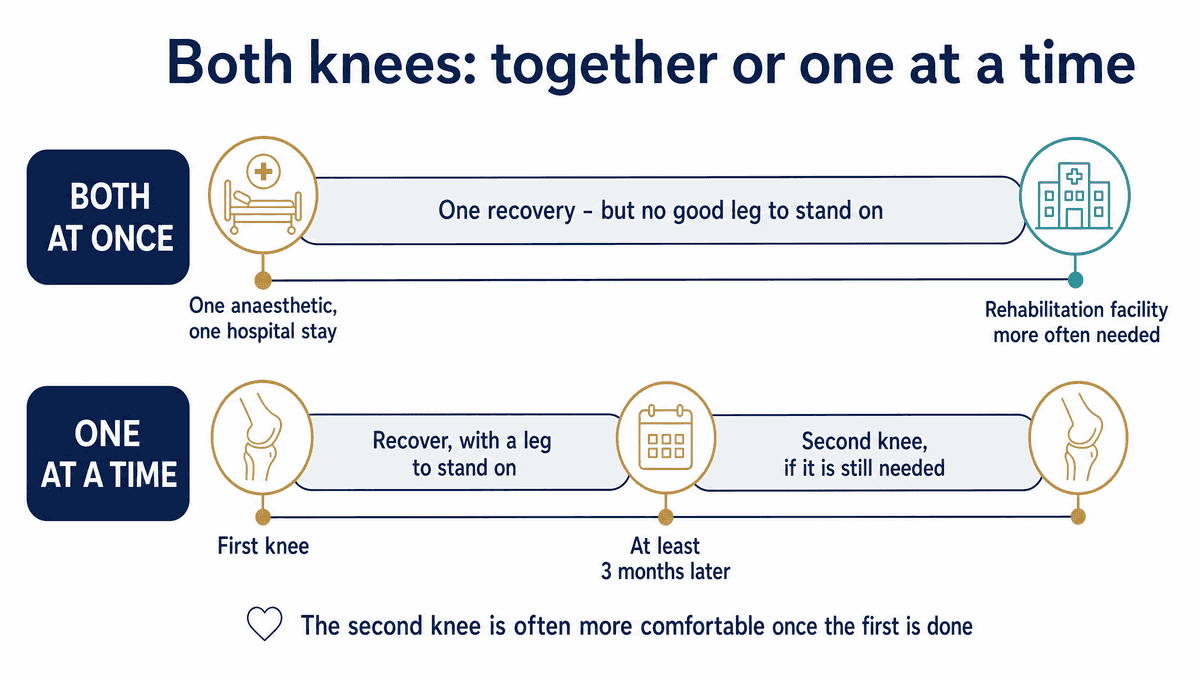
Simultaneous bilateral — both knees replaced under one anaesthetic, in one theatre visit. One admission, one recovery, one lot of time off.
Staged bilateral — two separate operations, most commonly at least three months apart. Two admissions, two recoveries, and a knee that works in between.
In Australia, staged is much the more common approach, and it is worth understanding why rather than assuming it is inertia.
The case for doing both at once
Not a small case. For the right patient it is a good operation.
- One anaesthetic instead of two. A meaningful consideration if anaesthesia worries you — see the anaesthetic for a knee replacement.
- One hospital admission, one recovery, one lot of time off work. For someone still working, the difference between one six-week absence and two is not trivial.
- Both legs corrected together. This matters most where both knees have a fixed bend or a significant bow. A new knee working against a badly deformed opposite leg is compromised by it, and correcting both at once avoids that.
- It is finished. Some people find the prospect of going through it twice worse than the operation itself, and that is a legitimate factor rather than a failure of nerve.
- Cost. One admission and one set of gap payments rather than two.
The case for one at a time
- Lower risk. The consistent finding across large series and registry data is that a simultaneous bilateral knee replacement carries higher rates of certain complications than a single knee replacement — blood transfusion, cardiac and respiratory events, and the need for a rehabilitation facility afterwards. In a fit patient the absolute numbers remain small, but the difference is real.
- A leg to stand on. This is the practical one, and it is the thing patients most consistently say afterwards they had not appreciated in advance.
- Better rehabilitation. Physiotherapy after a knee replacement is demanding, and two knees compete for the same limited energy. Each knee gets more of it when it is on its own.
- You find out whether the second one is needed. More on this below, because it is the argument that changes the most minds.
- You can change your mind. Having gone through one, some people choose to wait on the second, and having that choice is worth something.
The second knee often gets better on its own
Worth its own section, because it surprises people and because it is genuinely common.
An arthritic knee changes how you walk. You favour it, you shorten your stride, you load the other leg differently, and the other leg complains. When the worse knee is replaced and the limp resolves, the second knee is often considerably more comfortable than it was — sometimes to the point where the second operation moves from “in three months” to “not yet”.
Some of that is load redistributing. Some of it is that the second knee was never as bad as living with the first made it feel. Either way, a proportion of people who arrive expecting two operations end up having one for a good deal longer than they planned.
You cannot find this out after a simultaneous operation. That is the honest cost of doing both at once, and for many people it is the deciding argument.
What the first fortnight is actually like with two
The difference is not that everything hurts twice as much. It is that the strategy changes.
After one knee replacement, almost everything you do in the first weeks leans on the other leg: standing from a chair, getting on and off the toilet, leading up a step and down with the operated leg, getting into bed, turning over.
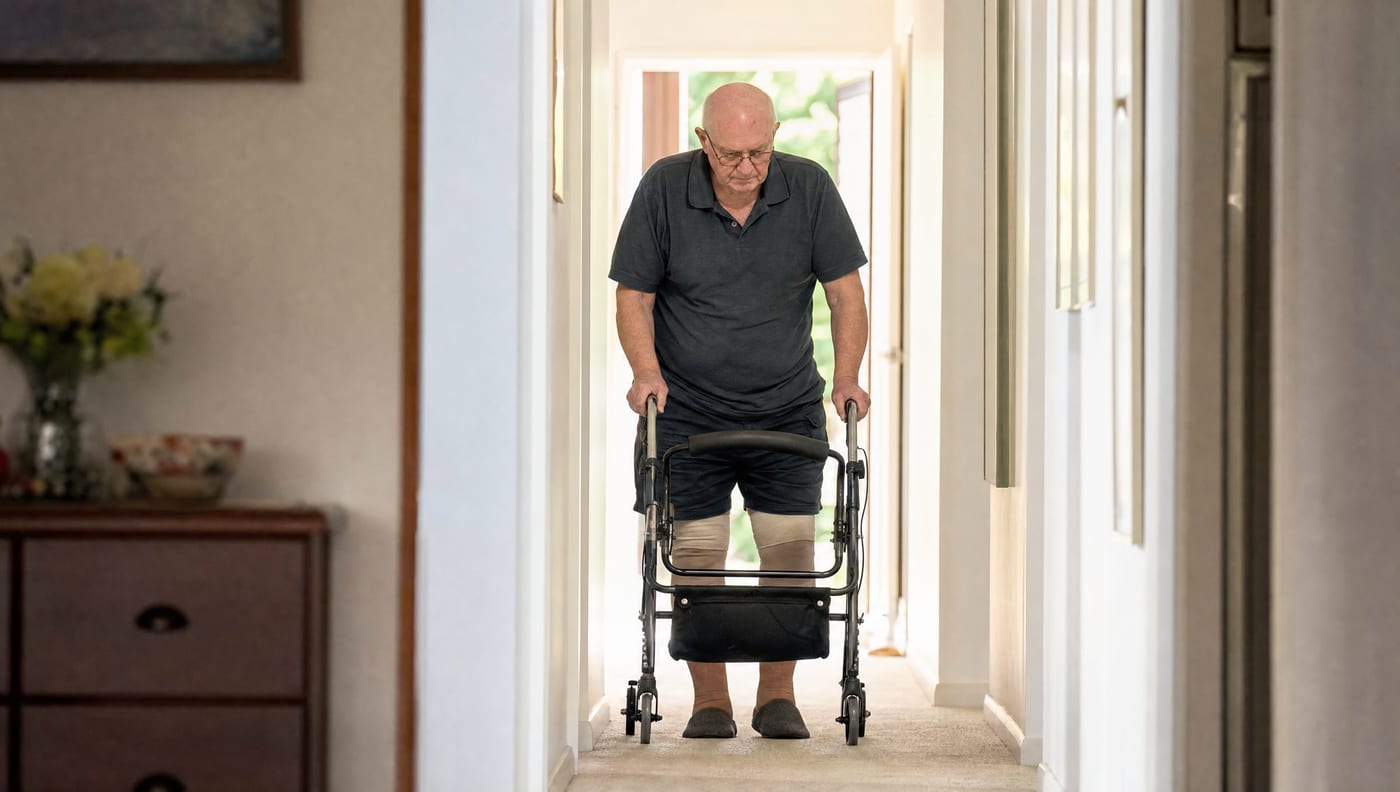
With two, none of that is available. The work shifts to your arms and shoulders. A wheeled frame is used for longer, transfers are slower, and stairs are a genuine problem rather than an inconvenience — which matters if the bathroom is upstairs.
The practical consequences:
- A rehabilitation facility is more often needed, and it should be planned for rather than treated as a failure
- Someone at home is close to essential for the first two to three weeks
- Driving takes longer to return, because both legs are recovering
- Upper body strength before surgery is worth working on, which is not usually advice given to knee patients. Preparing for a knee replacement covers the rest of the preparation
- Set the house up for a ground-floor fortnight if you possibly can
By six to twelve weeks the two paths largely converge. It is the first few weeks where the difference is stark.
How the decision is made
It is a conversation rather than a formula, and it turns on three things.
Are you fit enough? The assessment before a simultaneous bilateral operation is more searching than before a single knee. Heart and lung function matter most, because the physiological load of two joint replacements in one sitting is considerably greater than one. Age by itself is not the criterion; fitness is.
Are both knees genuinely equally bad? Where one knee clearly dominates the symptoms, doing that one first answers the question about the other for free.
What does home look like? Who is there, how many steps, where the bathroom is, and how long help is available for. A simultaneous operation asks a great deal more of the household.
Where the answer to all three is favourable — a medically fit patient, two badly affected knees with deformity in both, and real support at home — doing them together is a reasonable choice and the advantages are real. Where any of the three is in doubt, staging is the more conservative path and very little is lost by it.
Worth raising at your consultation
Bring the question explicitly. It is one of the few decisions in knee replacement where patient preference legitimately carries weight alongside the clinical assessment, and it is easier to discuss properly before a date is set than afterwards.
Things worth telling your surgeon:
- How much each knee actually limits you, separately rather than together
- Whether you live alone, and how many steps are involved at home
- What help you can genuinely call on, and for how long
- Any heart or lung condition, and how much you can do before you get short of breath
- Whether one knee has a fixed bend or a visible bow
- What you are trying to get back to, and by when
Next: Total knee replacement — or read about how the knee is opened, and what gets marketed.
Can both knees be replaced at the same time?+
Yes, and it is called a simultaneous bilateral knee replacement — both knees done under one anaesthetic, in one theatre visit, with one hospital stay and one recovery. It is a genuine option for a relatively narrow group of patients: people who are medically fit, without significant heart or lung disease, whose knees are both badly affected, and who have substantial help at home. In Australia the large majority of patients needing both knees replaced have them done separately, and that reflects the balance of risk rather than a lack of willingness to do them together.
Is it safer to have both knees done at once or one at a time?+
Doing them separately carries less risk. Large series and registry data consistently show that a simultaneous bilateral knee replacement is associated with higher rates of certain complications than a single knee replacement — including the need for blood transfusion, cardiac and respiratory events, and transfer to a rehabilitation facility. The absolute figures are still small in a fit patient, which is why it remains a reasonable option for some. The point is that the trade-off is real and it should be stated rather than glossed over.
What are the advantages of doing both knees at once?+
One anaesthetic instead of two. One hospital admission. One period off work rather than two separated by months. One rehabilitation programme. Both legs corrected together, which matters where both knees have a fixed bend or a significant deformity, because a single new knee still has to work alongside a bad one. And for some people, simply getting it over with — which is a legitimate consideration, not a frivolous one.
How long between the first and second knee replacement if they are staged?+
Usually a minimum of around three months, and commonly three to six. The interval allows the first knee to recover enough to support the second, lets the elevated clot risk after the first operation pass, and means the rehabilitation for each knee gets proper attention rather than competing. Some people wait considerably longer by choice, and there is no deadline — the second knee can be done when it needs doing.
What is the recovery like with two new knees?+
Harder than one, and harder in a specific way: there is no good leg. Standing from a chair, getting on and off the toilet, managing stairs and getting in and out of bed all rely on the unoperated leg after a single knee replacement, and with two operated knees that strategy is not available. Upper body strength does more of the work, a wheeled frame is used for longer, and a period in a rehabilitation facility is more often needed. Beyond the first few weeks the two paths converge.
My second knee stopped hurting after the first was replaced. Why?+
It happens often enough to be worth planning for. An arthritic knee changes how you walk and how load is shared, and a knee that appeared to need replacing sometimes becomes considerably more comfortable once the worse one is fixed, the limp resolves and load redistributes. Some of it is that the second knee was never quite as bad as the first made it feel. This is one of the stronger practical arguments for staging: you find out whether the second operation is actually needed before committing to it.
Can one knee have a partial replacement and the other a total?+
Yes. The two knees are assessed independently, and it is not unusual for the pattern of arthritis to differ between them — one confined to a single compartment and suitable for a partial replacement, the other affecting two or more and needing a total. Whether they are done together or separately is a separate question from which operation each knee needs.