
Hip Replacement Recovery: What to Expect, Week by Week
A week-by-week guide to recovering from a hip replacement — the hospital stay, the first fortnight, when you can drive, and how the anterior and posterior approaches differ in what you are allowed to do.

Most people arrive expecting hip replacement to be an ordeal and are quietly astonished by how ordinary the first week turns out to be. The arthritic pain — the thing that has been waking them at night for two years — is simply gone when they come round, and what is left is surgical soreness, which behaves itself and fades.
That is genuinely how it usually goes. It is also the reason this page spends as much time on restraint as it does on effort.
What follows is the shape of the months ahead: the hospital stay, the fortnight at home, the point at which driving becomes reasonable, and the first year. About seven minutes to read. If you have not yet decided on surgery, start with Do I Need a Hip Replacement? instead, and the hip replacement page covers the operation itself.
The short version
| When | What is usually happening |
|---|---|
| Day 0 | Surgery. Often standing and taking first steps the same day |
| Day 1 | Walking with a physiotherapist. X-ray to confirm implant position |
| Days 1–2 | Home for most people, once safe and comfortable |
| Weeks 1–2 | Home. Walking aid, regular pain relief, exercises three times daily |
| Week 2 | Review with Dr Clark — wound checked, pain management adjusted |
| Weeks 2–6 | Off the walking aid for most people. Stride and confidence returning |
| Around week 6 | Driving becomes possible for most, once safe and off opioid pain relief |
| Weeks 6–12 | Everyday activities feel manageable again |
| 3–12 months | Strength, stamina and the sense that the hip is yours keep building |
Treat the table as a rough map rather than a schedule. Hips vary, and so do the people attached to them — how much muscle the arthritis had already taken, what else you are managing medically, how stiff things had become. Running a fortnight behind any of these markers is common and means very little.
The approach changes what you are allowed to do
Two people can have the same operation in the same week and be given quite different rules. This is why.
After a direct anterior approach there are no post-operative movement restrictions. Sleep however you like. Bend forward, cross your legs, reach for your shoes. Nothing is off limits. The reason is structural. The muscles at the back of the hip — the ones that normally hold the joint in place — are never touched. The surgeon comes in from the front, through a natural gap between muscles rather than through the muscles themselves. Nothing back there needs protecting while it heals, because nothing back there was disturbed.
After a posterior approach you will be given a set of precautions, usually for some weeks: no deep bending at the hip, no crossing the legs, and no turning the operated leg inwards. Those three positions are the ones that put a new joint at risk before the soft tissues have knitted, and the precautions exist for exactly as long as that risk does.
Dr Clark’s general preference is the anterior approach where a patient suits it. Not everyone does, and getting the components in the right position matters far more than the route taken to place them.
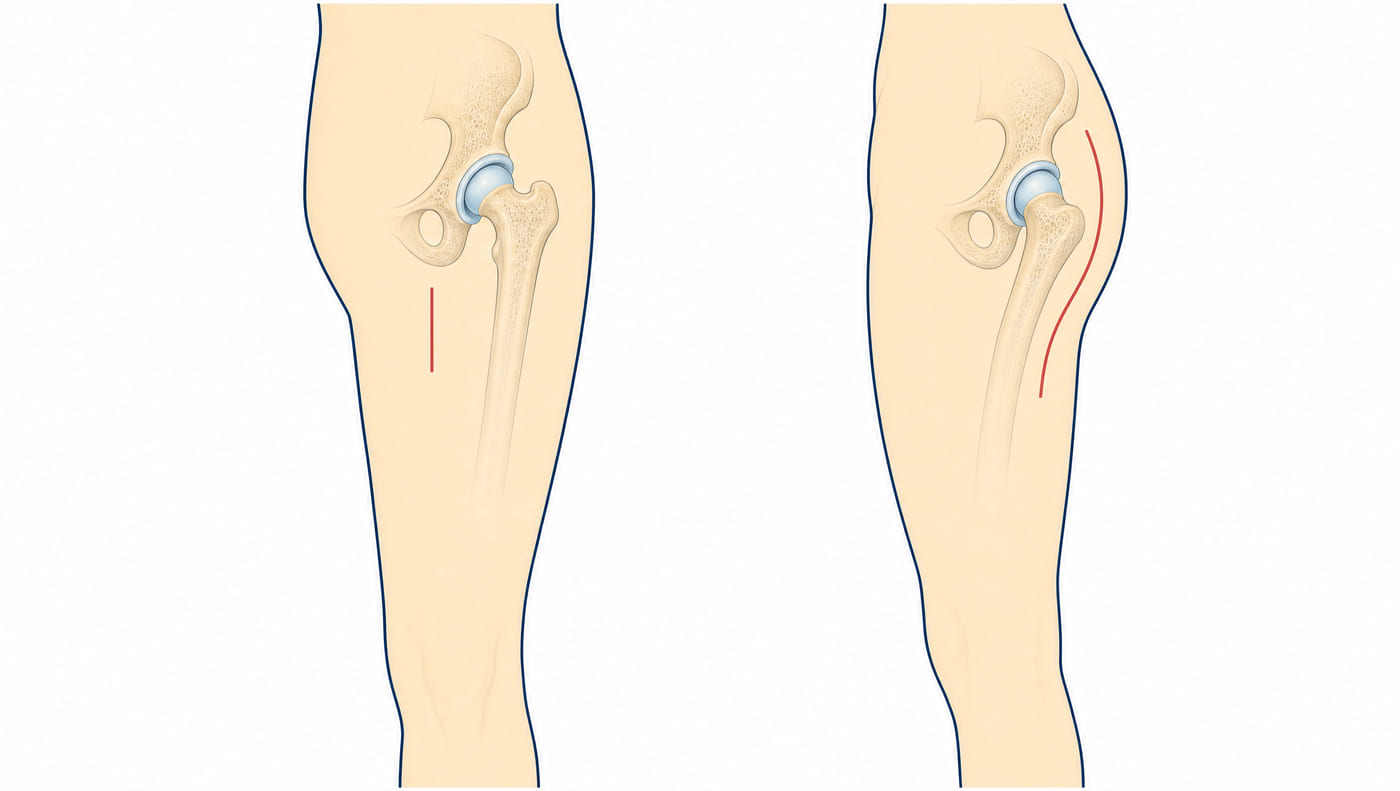
One thing to be firm about: the instructions that apply to you are the ones you were given in hospital. Hip replacement is discussed endlessly in waiting rooms and online, and much of what you will hear describes a different approach from a different decade. Your discharge sheet wins.
In hospital: days 0 to 2
One or two nights, and occasionally people go home the same day.
The speed at which you are asked to get up catches most people out. Many are standing within hours and walking a corridor with a physiotherapist the next morning. There is nothing gung-ho about it — early movement keeps the circulation going, lowers the clot risk, and stops the hip setting into the stiffness it would otherwise reach for.
Over those days you can expect physiotherapy starting the day of surgery or the morning after, working up from standing to a short walk to a practice run at the stairs before you leave. An X-ray on the ward confirms the position of the components, though films are also taken in theatre so anything needing adjustment is dealt with before the operation finishes. The dressing goes on in theatre and generally stays put for a fortnight. And you will be back in your own clothes and eating in a chair sooner than you imagine.
Four things have to be true before you go: pain controlled by tablets, a dry dressing, a physiotherapist content that you can move about and manage stairs, and normal bladder and bowel function.
Some people need a spell on a rehabilitation ward first. That is a route, not a failure.
Weeks 1 to 2: the fortnight at home
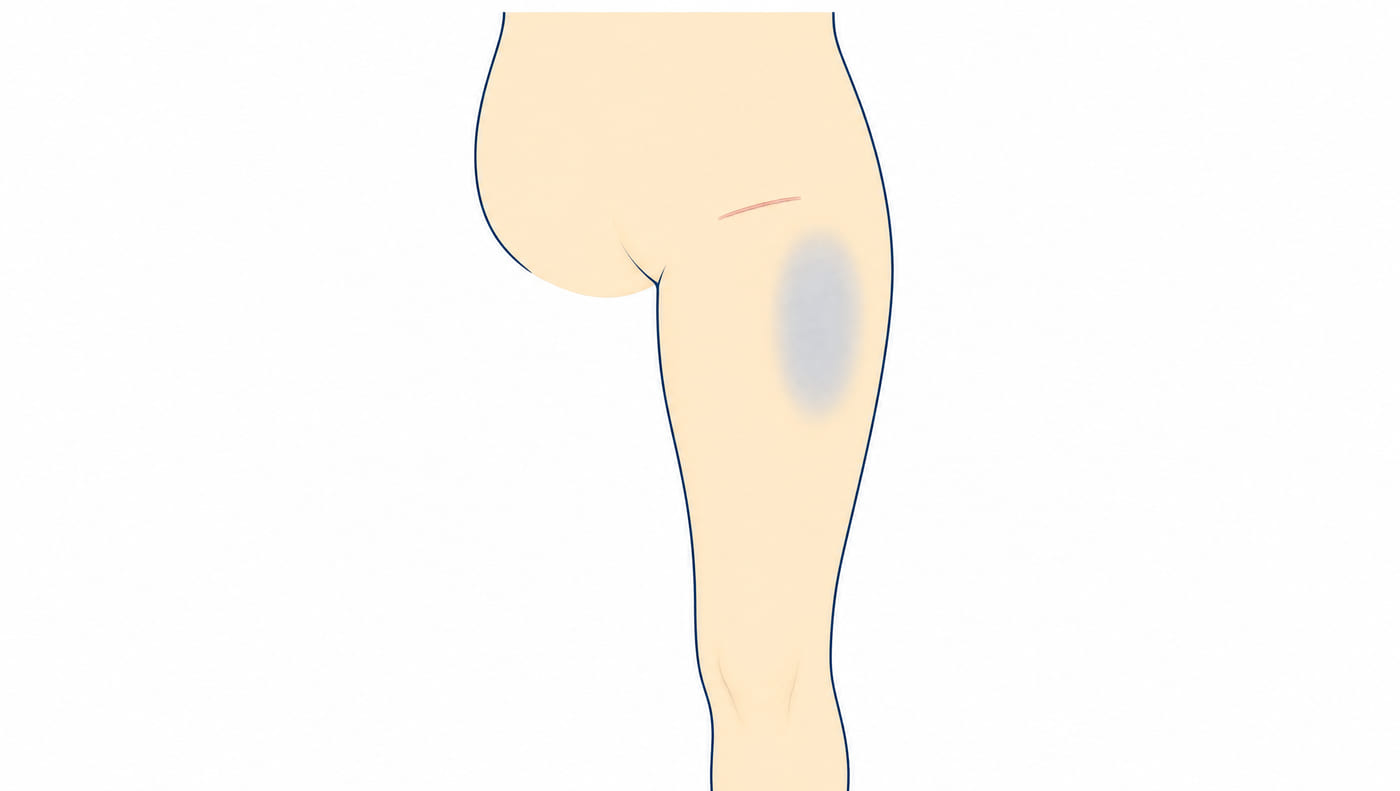
Bruising is the surprise here. It tends to arrive a few days in — later than you would expect — and can track a remarkable distance down the thigh, sometimes as far as the knee or the ankle, in colours nobody warned you about. It looks alarming, it is gravity doing what gravity does with a bit of blood in the tissues, and it fades.
Otherwise: crutches or a stick, a sore hip and thigh, evenings worse than mornings.
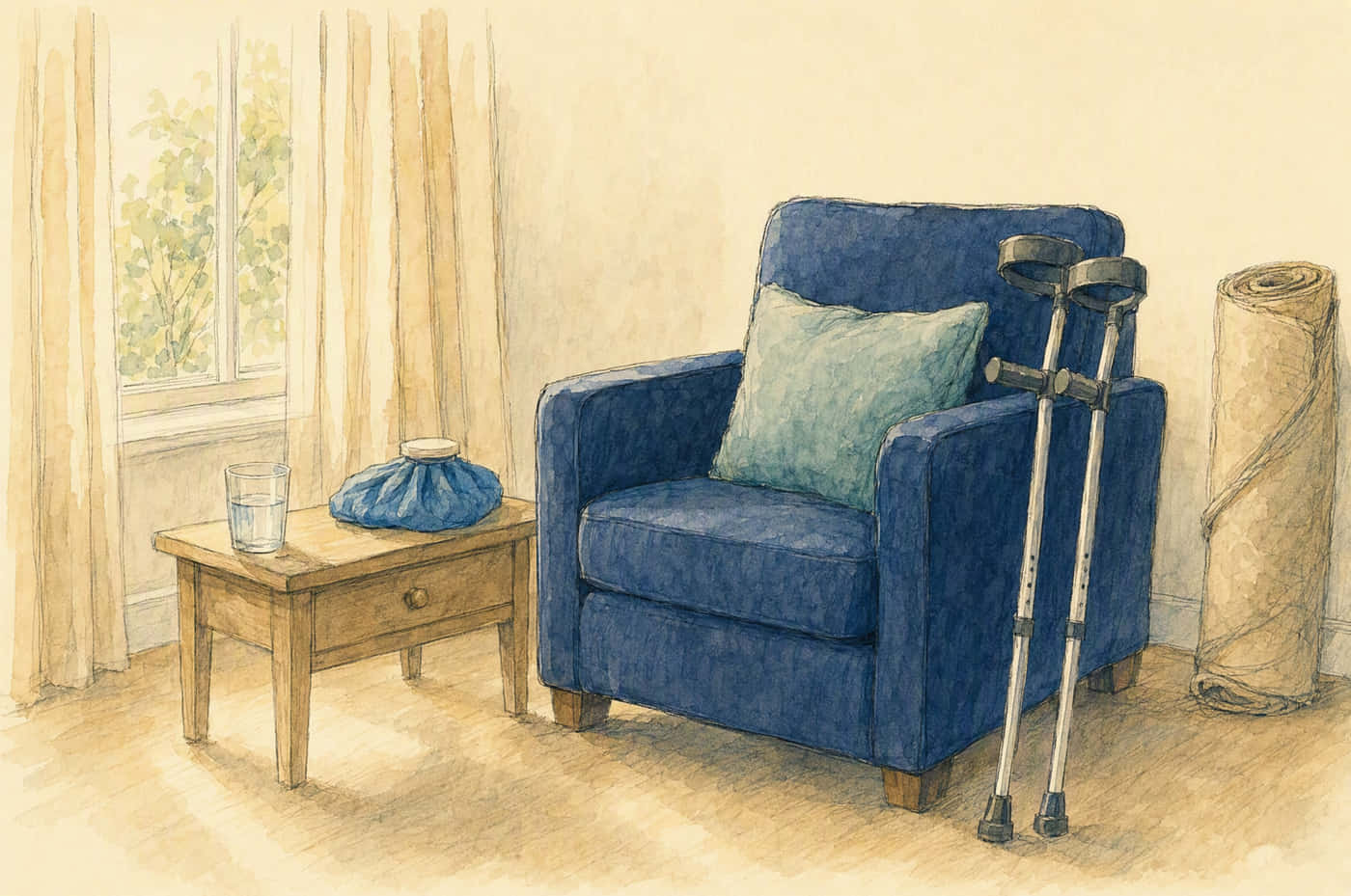
Take the pain relief. People try to be stoic, cut it back in the first week, and then find the exercises hurt enough that they skimp on those too. The medication is not there to make you comfortable for its own sake; it is there so you can do the work.
Exercises, three times a day. You will go home with a specific set. Do them on the flat days as well as the good ones — that is the whole trick, and there is not a more sophisticated one.
Little and often. Several short walks beat one ambitious outing that leaves the hip swollen until Thursday.
Watch the leg, not just the hip. Some puffiness down the leg and into the ankle is ordinary and settles with the foot up. A calf that becomes painful and tender on one side is a different matter and warrants a phone call the same day.
Deal with the floor before you come home. Rugs, cords, the low stool nobody ever moves. Five minutes of tidying beforehand is worth more than any amount of care afterwards.
You will see Dr Clark at around a fortnight, when the wound is checked, pain relief is reviewed and ongoing physiotherapy is sorted out.
Weeks 2 to 6: stride, strength and confidence
The work changes character here. Up to now you have been protecting the hip; from here you start asking things of it.
Crutches usually give way to a single stick, and the stick to nothing at all, somewhere between two and six weeks. What holds people back at that point is rarely the hip — it is nerve.
Two things deserve your attention more than the rest.
The limp is a habit, and habits outlive their reasons. If you spent three years favouring that side, your body learned a way of walking that made sense at the time and has now been made redundant by the surgery. It does not update itself. Thinking consciously about even step lengths, in front of a window or a mirror, is a real part of the rehabilitation and is much easier to sort out now than in a year.
The muscles on the outer hip are the ones that matter. They keep your pelvis level when you stand on one leg, and a long stretch of arthritis almost always leaves them wasted. They are also the difference between walking that feels steady and walking that feels like work. Your physiotherapist will go after them — let them.
A day where the hip is sore because yesterday was busy is not a setback. It is the hip telling you where the line currently sits.
When can I drive again?
Six weeks for most, sometimes sooner, and a left hip in an automatic is the easiest case of all.
The date is not the test, though. You need to be off the opioid medication, in and out of the car without having to plan it, and comfortable working the pedals. Then the one that actually decides it — could you brake hard, right now, without a moment’s hesitation? If you had a posterior approach, dropping into a low seat may also still fall under your precautions.
Try a quiet street before you take on traffic, check where your insurer stands, and raise it at your review.
Weeks 6 to 12: back to ordinary life
Most people are walking unaided, doing stairs without thinking, and back at work by now if the work is not physical. Desk jobs often return sooner; anything involving ladders, lifting or a full day on your feet needs discussing on its own terms.
A few things are entirely normal at this stage and still catch people out:
- A numb patch on the outer thigh, especially after an anterior approach. A skin nerve runs near the route and objects to being disturbed. It usually shrinks over some months; a small patch sometimes stays for good. It has no bearing on how the hip works.
- Clicks and small internal movements. Soft tissues rearranging themselves around components that were not there before.
- A sense that one leg is now longer. Common, and usually not what it feels like. After years of standing crooked, a pelvis that has finally been levelled reads as wrong for a while. It generally settles. If a genuine difference persists and bothers you, a shoe insert deals with it.
- Aching at the end of a long day. For months yet. Unremarkable.
Aim at low-impact activity: walking, cycling, the stationary bike, and swimming once the wound has completely healed.
Three months to a year
The curve flattens without ever quite levelling off. Most of the gain in pain and function has landed by three to six months. What the rest of the year does is quieter — it turns a hip that works into a hip you have stopped thinking about, which is really the point of the whole exercise.
Three things look after the joint from here: a sensible weight, regular low-impact activity, and staying off repetitive high-impact loading. Roughly nine in ten hip replacements are still in place and working well at eighteen years, and how they are treated across those years is not incidental to that figure.
What actually slows people down
Feeling well too soon. Almost everyone’s problem, and specific to this operation — knees do not tempt you like this. The hip feels good, you do a proper day, and it takes three to get back. Build up gradually and read the flare-ups as pacing information.
Rationing the pain relief. Covered above and worth the repetition, because it is the most common way people make the first fortnight harder than it needed to be.
Letting the exercises slide. Especially the outer-hip work, which is dull and which nothing else replaces. Walking alone will not rebuild those muscles, and the limp stays until they come back.
Treating posterior precautions as advisory. They are time-limited and they are there to keep the joint where it belongs. Keep to them for as long as you were told, not as long as feels necessary.
Sitting on a worry. People hold off ringing because they assume they are being a nuisance. The overwhelming majority of these calls end with reassurance, which is a perfectly good outcome for a phone call.
Eating and sleeping
Unglamorous, and it genuinely shows in how you heal.
- Protein at every meal — meat, fish, eggs, dairy, legumes. Appetite tends to dip after surgery precisely when the body needs more of it
- Calcium and vitamin D, which matter here because your own bone is what the implant is relying on
- Fluids. Under-drinking in the first week is common and helps nothing
- Sleep whenever you can get it, naps included. Broken nights are normal early and improve as the soreness goes
The bit nobody mentions
A flat patch somewhere in the first few weeks is so common it may as well be part of the operation. You have had major surgery, you are relying on other people more than you are used to, your sleep is broken, and the daily leaps forward from week one have become weekly nudges by week four.
It lifts. Company helps, so does getting out of the house once a day even briefly, and so does remembering that six weeks feels vast from inside it and unremarkable from a year later. If it does not lift, say so — to your GP or to the rooms. It is an entirely ordinary thing to raise.
When to phone the rooms on (08) 6332 6365
Do not wait for your next appointment if you notice:
- Fever or chills, or feeling generally unwell
- Increasing redness, heat or spreading swelling around the wound
- Discharge or fluid coming from the wound
- Pain that is escalating rather than gradually easing
- Calf pain, tenderness or swelling, particularly one-sided
- A sudden change in leg length or position, an inability to weight bear, or severe pain after a twist or a fall — this needs to be seen urgently
- Sudden shortness of breath or chest pain — this one is an emergency, call 000
Phoning early about something that turns out to be normal is always the right call.
Getting the most out of it
Surgery decides what the hip is capable of. The next three months decide how much of that you actually get.
For what it is worth, the people who end up most pleased are almost never the ones who attacked it hardest. They are the ones who stayed on top of the pain relief, kept the exercises going when they were bored of them, took the bad days as information rather than evidence, and picked up the phone when something felt off.
Questions about your own recovery, or still deciding whether a hip replacement is the right move? Book a consultation or phone the rooms on (08) 6332 6365. Dr Clark consults at Murdoch and Mandurah.
This is general information and does not override what your own surgeon and physiotherapist have told you. Where the two differ, follow theirs — it accounts for your hip, your approach and your circumstances.
How long does it take to recover from a hip replacement?+
Most people walk the day after surgery and go home after one to two nights. Walking aids are typically set aside somewhere between two and six weeks, and many people are back to normal activities within about six weeks. Full recovery — strength, stamina, the hip feeling entirely your own — takes six to twelve months.
How long will I be in hospital after a hip replacement?+
One or two nights for most people, which surprises those expecting the longer stay a knee replacement involves. What decides it is not the calendar but four practical things: tablets are holding your pain, the dressing is dry, a physiotherapist is satisfied you can get about and handle stairs, and your bladder and bowels have woken up again after the anaesthetic.
Are there movement restrictions after a hip replacement?+
It depends on the approach. After a direct anterior approach there are no post-operative movement restrictions — you may sleep in any position and bend forward freely, because the structures at the back of the hip that resist dislocation are left undisturbed. After a posterior approach you will be given precautions to follow for a period, typically avoiding deep bending, crossing the legs and turning the operated leg inwards. Follow the instructions you were given, because they are specific to the operation you had.
When can I drive after a hip replacement?+
Six weeks suits most people, and a left hip in an automatic is often sooner. Nobody can sign this off by date alone, though. You have to be off the opioid medication, getting in and out of the car without having to think about it, and certain you could stamp on the brake for a child running out. If any of that is still in doubt, you are not ready. Try a quiet street first, check where your insurer stands, and raise it at your review.
Why is my thigh numb after a hip replacement?+
A nerve supplying sensation to the skin over the outer thigh runs close to the direct anterior approach, and irritation of it can leave a patch of numbness, tingling or altered sensation there. It is common, usually settles over months, and does not affect how the hip works — though a small area of altered sensation can persist.
Will my legs be different lengths after a hip replacement?+
Small differences are possible, and restoring leg length is one of the things planned before and checked during the operation, with X-rays taken before surgery finishes. Many people who feel longer or shorter early on are feeling tight soft tissues and a pelvis that has been habitually tilted for years, and the sensation settles as things loosen. A genuine difference that remains bothersome is usually managed simply, with a shoe insert.
How much pain is normal after a hip replacement?+
Most people report less than they braced themselves for, particularly after an anterior approach — the arthritic pain they arrived with is gone from the moment they wake, and what replaces it is surgical soreness that fades. Expect a few weeks of it, easing week on week. The pattern matters more than the level: soreness that is climbing rather than settling, or that arrives with a fever, spreading redness, wound discharge or a tender calf, is not part of the picture. Ring the rooms.
When can I sleep on my side after a hip replacement?+
After an anterior approach you may sleep in any position from the outset, comfort permitting — most people find lying on the operated side tender for a few weeks simply because of the wound. After a posterior approach, follow the specific advice you were given, which usually involves a period of sleeping on your back or with a pillow between the knees.