
Sport and Hobbies After a Knee Replacement
Which sports are usually fine after a knee replacement, which are decided case by case and which are usually advised against: golf, swimming, cycling, doubles tennis, pickleball, hiking and skiing.
The question behind this one is rarely “can I play sport”. It is what can I get back to, and what might it cost the knee? People ask it before they have booked the operation, and it is a fair thing to want answered.
The answer depends far more on how the activity loads the knee than on its name. Impact, twisting and the chance of a hard fall matter much more than whether the sport is a social one.
The short version
Roughly, activities fall into three groups. The figure below is a general guide, and individual advice is set at your review.
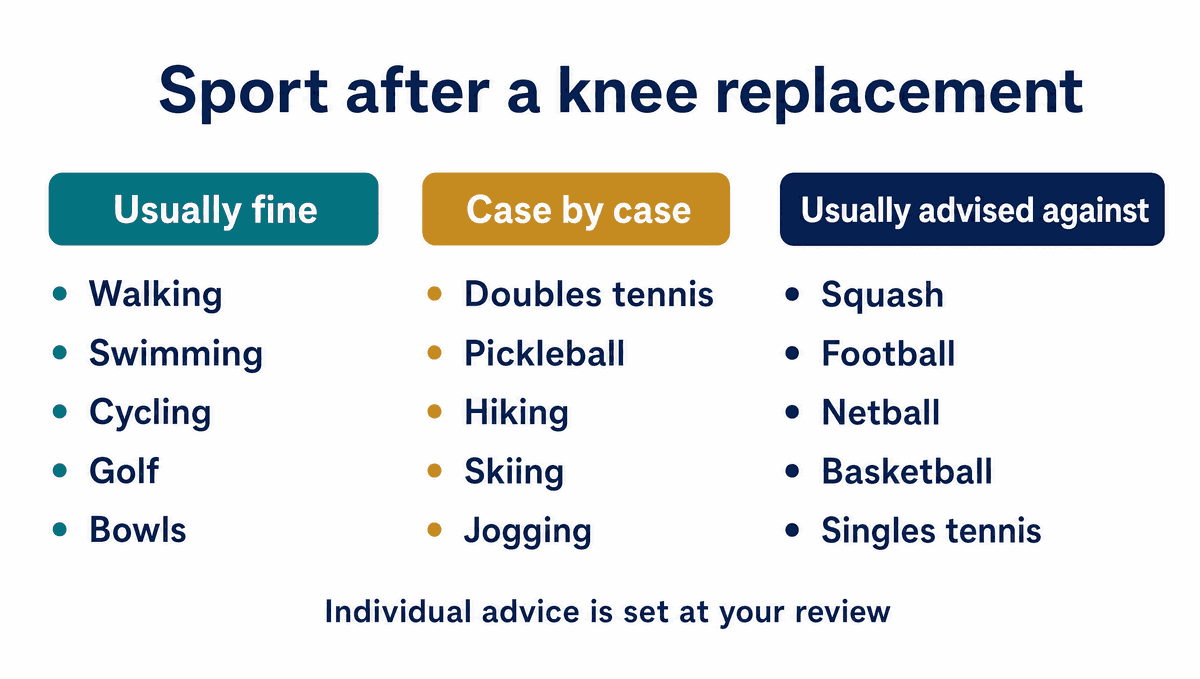
There is limited high-quality evidence on exactly how much impact a knee replacement tolerates over decades, and surgeons differ. What most agree on is the direction: a knee replacement is a mechanical device with a finite working life, and the activities that load it repeatedly, twist it or put it at risk of a fall are the ones that shorten it or threaten it.
The aim of the operation is a knee that lets you do the things that matter without pain. It is not a way back to every sport you played at twenty-five. Both of those statements can be true at once.
What the research shows
The evidence is mostly surveys and cohort studies, and it points the same way as the chart above.
- Surgeon consensus. In a survey of 120 members of the European Knee Associates, walking, stair climbing, swimming, aqua fitness and static cycling were recommended in the first six weeks, and cycling on level ground and yoga from six to twelve weeks. Doubles tennis, golf, weight training, aerobics and hiking were recommended from three to six months. Squash was the one sport they consistently advised against (Thaler 2021)
- How many return. A meta-analysis of 44 studies found that about 82% of patients return to sport after a total knee replacement, at a mean of about 20 weeks. Around 76% returned to low-intensity sports, against about 35% for high-intensity sports (Pasqualini 2023)
- Golf specifically. In 143 regular golfers followed for at least two years, the average time back on an 18-hole course was 3.7 months (Pioger 2020)
- Athletes. In a cohort of 1,464 patients who were athletes before surgery, 53% had returned to sport within a year, half within about 12 weeks. Of those who returned, 62% were back at their previous level and 34% at a reduced intensity (Soares 2026)
None of these is a promise about your knee. They describe groups of people, and your own advice is set at your review.
What has to be true first
Before any return to sport, the knee should be able to do the ordinary things well:
- Walking comfortably without a limp, for longer than the sport demands
- Little or no swelling the day after a hard session
- Enough bend and full straightening for the movement the sport asks of it. Bending and straightening after surgery sets out the figures
- A thigh muscle that works, so that the knee does not buckle when you stop or turn. This is the one most often missing, and it is the one most protective
If those are not true yet, the sport is not the problem. The recovery is not finished.
Activity by activity
Walking. Where it starts, and a good measure of progress. Distance is built up over months. Knee replacement recovery shows what the usual pace looks like.
Swimming and water exercise. Once the wound is fully healed and you have been cleared, usually in the first six weeks. Freestyle and backstroke are straightforward. Some people find the breaststroke kick uncomfortable early on. Kicking feels strange for a while, and that is ordinary.
Cycling. A stationary bike is part of rehabilitation from the early weeks, because it works the bend without loading the knee. Riding on level ground is commonly allowed from about six to twelve weeks, and road or trail riding from about three months, when balance and confidence are back. A fall from a bike is the risk, not the pedalling.
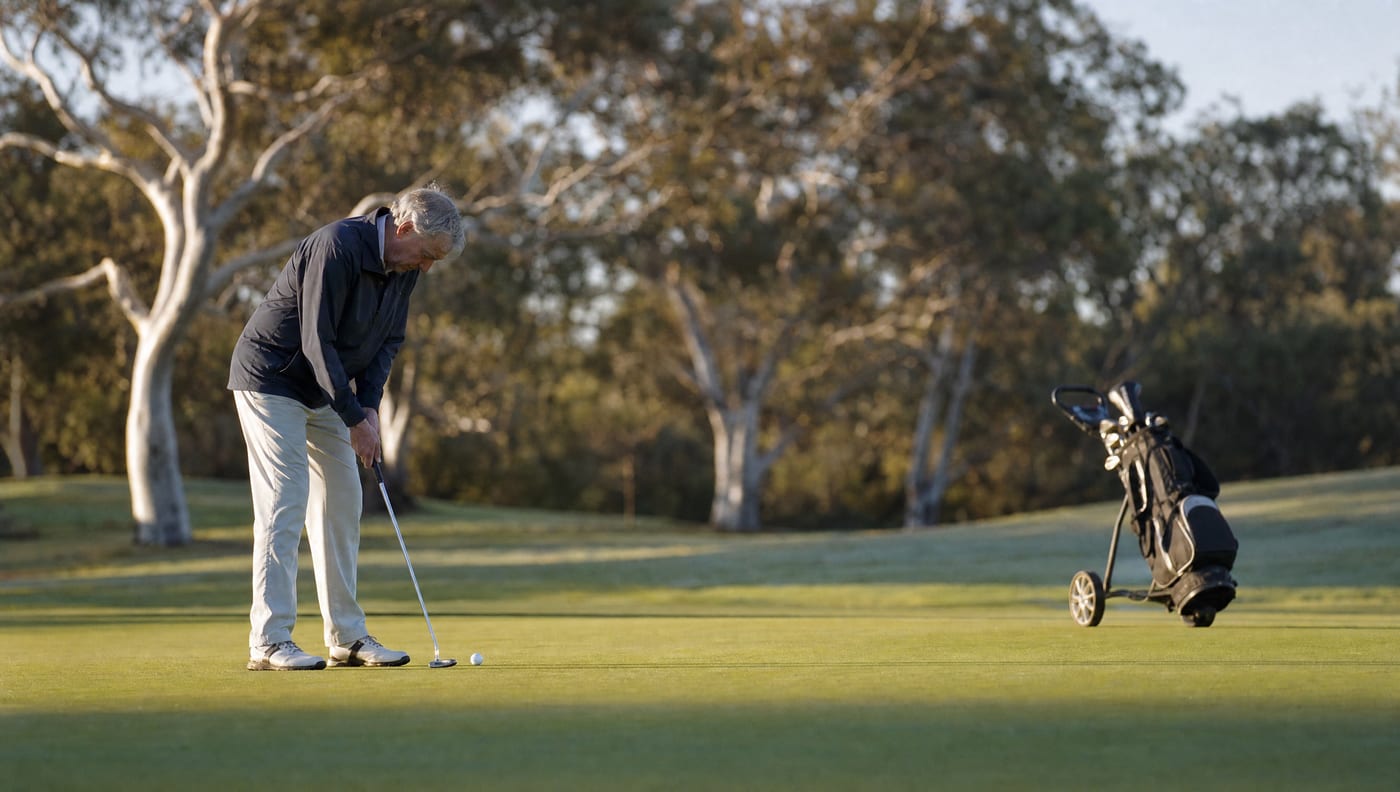
Golf. Usually fine, and one of the activities most often resumed. Putting and chipping first, then the range, then a round on a cart, then walking the course. The swing’s rotation is the part to build up gently.
Bowls. Usually fine. The delivery involves a lunge and a step, so start gently and adapt the stance if needed.
Doubles tennis and pickleball. Case by case. The risk is the lunging, the stopping and the quick changes of direction, and the possibility of a fall. Singles tennis asks much more of the knee and is usually advised against.
Hiking and bushwalking. Usually yes, built up from flat, even ground. Downhill is harder than uphill, uneven ground raises the chance of a fall, and walking poles help.
Skiing. Case by case, and a conversation worth having before the operation. Experienced skiers sometimes return to groomed runs once the leg is strong. Twisting forces and the consequences of a fall are the concerns.
Jogging and running. Discussed individually. Whether running is reasonable after a knee replacement has its own page.
Gym and strength work. Encouraged. Leg press, step-ups, rowing and cable work are all used. Heavy loaded deep squats and jumping are the parts to discuss.
Dancing. Usually fine in the form most people do, with attention to the pivots and spins.
Squash, football, netball, basketball, contact sport. Usually advised against. Each combines repeated impact, hard pivoting and a real chance of collision or a heavy fall.
Building back in
The most reliable approach is also the dullest.
- Return at a fraction of what you did before. A quarter of the previous volume, for several weeks, then step up.
- One new thing at a time. Changing the activity, the surface and the intensity at once is how a settled knee gets angry.
- Warm up properly, and expect the first ten minutes to be stiff.
- Treat swelling the next day as information. If it is up, the load was too much. Ease for a few days and build again.
- Choose shoes and surfaces deliberately. Cushioned, stable shoes, and surfaces that forgive. Grass over concrete.
- Strengthen the leg alongside it. The sport does not rebuild the muscle that the sport depends on.
A fall is the single most important risk in most of these activities, more than the pounding. If you do fall after your operation, the warning signs page sets out what needs a same-day call.
If sport is the reason you are thinking about surgery
Tell your surgeon what you want to get back to, in as much detail as you can. It changes the conversation: how realistic the goal is, what the alternatives are, and in some cases whether a partial or a total replacement suits you better. Partial versus total knee replacement covers how that decision is made.
It is also worth asking whether surgery is yet the right step at all. Non-surgical knee treatment sets out what is available first, and when I advise against surgery explains the cases where it is not the answer.
If you would like to talk about a specific sport, phone the rooms on (08) 6332 6365 or use the contact page.
Studies cited
All are indexed in PubMed.
- Thaler M et al. Twenty-one sports activities are recommended by the European Knee Associates (EKA) six months after total knee arthroplasty. Knee Surg Sports Traumatol Arthrosc 2021. doi:10.1007/s00167-020-06400-y
- Pasqualini I et al. Return to sports and return to work after total knee arthroplasty: a systematic review and meta-analysis. JBJS Rev 2023. doi:10.2106/JBJS.RVW.22.00250
- Pioger C et al. A playtime and handicap analysis of 143 regular golfers after total knee arthroplasty at minimum 2-year follow-up. J Arthroplasty 2020. doi:10.1016/j.arth.2020.01.005
- Soares RW et al. Return to sports after primary total knee arthroplasty: a prospective cohort study of 1782 patients. Am J Sports Med 2026. doi:10.1177/03635465251400357
Next: Looking after someone after a knee replacement — or flying after a knee replacement.
Can I play golf after a knee replacement?+
Yes, for most people, and it is one of the activities most often resumed. Many surgeons are happy with putting and chipping from around six to eight weeks and a full round from about three months, starting on a cart before walking the course. The twisting of the swing is the part to build up gradually. Spikeless shoes let the foot turn with the swing rather than gripping the ground.
Can I play tennis or pickleball after a knee replacement?+
Doubles is more often considered than singles, and it is decided case by case. The concern is not the ball, it is the sudden stops, lunges and changes of direction, plus the risk of a fall. People who played regularly before surgery and have strong, well-controlled legs are more likely to be cleared than people returning to a sport they had stopped. Start with gentle rallying on a forgiving surface and build.
Can I ski after a knee replacement?+
It is decided case by case rather than ruled out. Experienced skiers who were skiing confidently before surgery sometimes return to groomed runs once the leg is strong, and avoid moguls, ice and crowded slopes. The two issues are the twisting forces on the knee and the consequences of a fall. Tell your surgeon that skiing is the goal before the operation, not after.
What sports should I avoid after a knee replacement?+
Usually the ones with repeated jumping, hard pivoting or collision: squash, football, netball, basketball, singles tennis and contact sport. Each loads the implant repeatedly, twists the knee, or carries a real chance of a heavy fall. That is general advice, and an individual conversation will sometimes go differently.
Can I go hiking after a knee replacement?+
Usually yes, building up from flat, even ground. Downhill walking is harder on the knee than uphill, uneven ground raises the chance of a fall, and a long walk can swell the knee for a day or two. Walking poles help, and so does a pace that leaves you able to talk. The distances can be built up over months.
Is it safe to lift weights or use a gym after a knee replacement?+
Strength work is encouraged, because strong thigh and hip muscles protect the knee. Leg press, step-ups, cycling, rowing and cable work are all commonly used. The parts to discuss are heavy loaded deep squats, jumping and plyometrics. Start with modest loads and progress under the guidance of your physiotherapist.