
Treating Knee Arthritis in Perth
Treatment options for knee osteoarthritis in Perth — when surgery is considered, which operation suits which pattern of arthritis, and what happens if you wait. Assessment with Dr Rhys Clark at Murdoch and Mandurah.
This page covers treatment — what the options are for an arthritic knee, when surgery enters the conversation, and which operation suits which pattern of damage.
If you want the condition itself explained first — what arthritis is, what people commonly notice, and what non-surgical treatment involves — start with Understanding Knee Arthritis. It is written to be read before an appointment and takes about six minutes.
If you are not yet sure the problem is arthritis at all, two pages come earlier than this one: Where Your Knee Hurts covers what the location of pain suggests, and Is It Knee Arthritis or Something Else? separates arthritis from the conditions it is confused with.
The cartilage of the knee
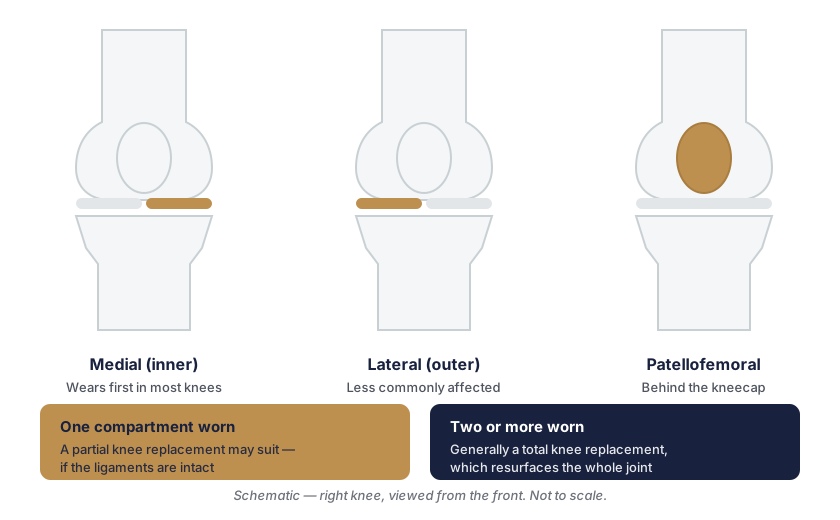
The cartilage you’re born with is the only cartilage you get. Once it’s damaged or worn out, it doesn’t regenerate. And, when it comes to the knee, there are three bones – the femur, tibia, and patella – that all have specialised cartilage to keep you moving freely and without pain.
“The knee is a very unique joint as it has three areas of cartilage that all have their own job to do. They are also individually susceptible to damage and pain,” says Dr Rhys Clark.
Which compartment is affected shapes both your symptoms and your treatment. Difficulty walking long distances usually points to arthritis on the ends of the bones; pain climbing stairs or standing from sitting more often suggests arthritis behind the kneecap.
“Pain is just one symptom of knee arthritis. Some patients also experience swelling, stiffness, muscle weakness, a change in their gait, cracking or grinding.”
Where treatment starts
Treating Knee Arthritis Without Surgery covers each option in detail — exercise, weight, cortisone, gel injections, supplements and PRP — measured against the Australian clinical guideline.
Surgery is rarely the first step. Most people work through some combination of:
- Physiotherapy and strengthening. Strong muscles around the knee take load off the joint. Some discomfort while building up is expected and is not a sign of damage.
- Pain and anti-inflammatory medication, used sensibly and reviewed with your GP.
- Corticosteroid injection. Can settle a flare and buy comfortable time, though the effect is temporary — usually weeks to a few months — and it does not change the underlying arthritis.
- Weight management. Three to four times your body weight passes through the knee with every step, so even a modest reduction takes a meaningful load off the joint.
- Activity modification and bracing in selected cases.
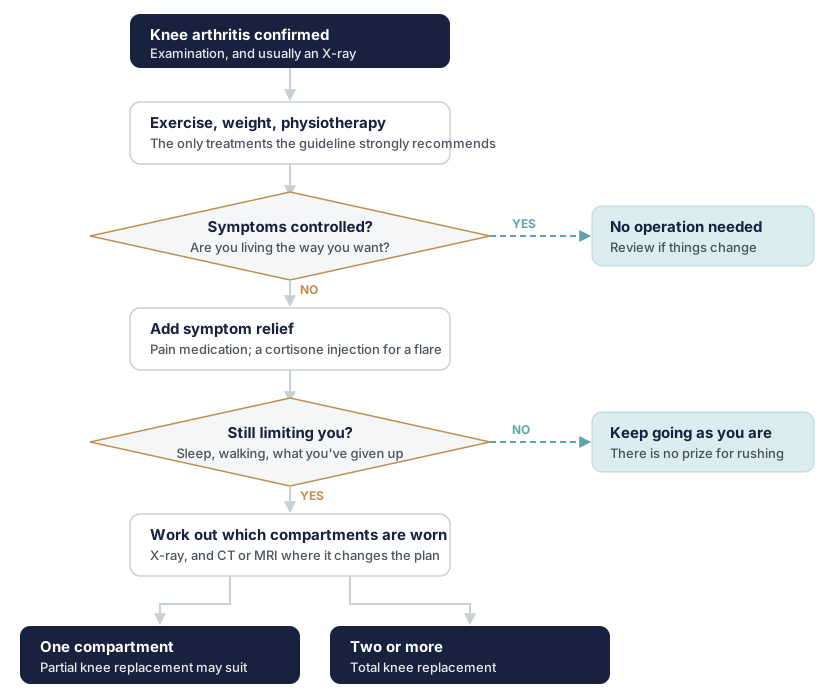
These are covered in more depth in Understanding Knee Arthritis. Surgery becomes a reasonable conversation when they are no longer holding the symptoms.
Most people leave that pathway before its end, and stay off it for years.
When is surgery actually considered?
Do I Need a Knee Replacement? works through this in full — the questions that actually matter, why the X-ray decides less than people assume, the age question, and what the operation can and cannot deliver.
There is no X-ray appearance and no age that automatically means it is time. Arthritis shows on the films of more than half of people over 65, and only about one in seven of them have symptoms worth treating.
What matters is the effect on your life. The questions worth asking yourself:
- Is pain limiting the things that matter to you — work, walking, sleep, the activities you would choose?
- Is it waking you at night, or making it hard to find a comfortable position?
- Have you narrowed what you do to avoid provoking it?
- Are non-surgical measures still making a real difference, or have they stopped working?
“Joint replacement surgeries are very effective at alleviating a patient’s pain. I’ve seen many people who have become immobilised due to their level of pain but, once they recover from surgery, they’re able to feel the joy of movement again.”
Is there a cost to waiting?
Patients often assume the safest course is to delay as long as humanly possible. That is worth examining rather than assuming.
There is no benefit in replacing a knee that is still manageable, and nobody should be rushed. But waiting is not cost-free either. Muscle weakens with reduced activity, and it has to be rebuilt afterwards. Other joints and the opposite leg take up the load. And a knee that becomes severely stiff or badly deformed can make the operation more technically demanding and the result less predictable than it would have been earlier.
The aim is not to operate as early as possible or as late as possible, but at the point where symptoms consistently outweigh what non-surgical treatment can offer.
Which operation?
The choice depends mainly on how many of the knee’s three compartments are affected, and on the state of your ligaments.
Partial knee replacement resurfaces a single damaged compartment and preserves everything else, including the cruciate ligaments. It suits single-compartment arthritis with intact ligaments, offers a quicker recovery and often a more natural-feeling knee — with a somewhat higher likelihood of further surgery later.
Total knee replacement replaces the whole joint surface and is generally used where two or more compartments are affected. It is the more common operation and is less likely to need revising.
Knee realignment surgery is an option in selected cases — typically younger patients with damage confined to one side of the knee and a correctable deformity, where shifting load away from the worn compartment can buy substantial time before any replacement is needed.
Both replacement operations are performed with robotic assistance, planned as a virtual pre-operation from a CT scan of your knee.
What happens at your appointment
Assessment involves your history — what the knee stops you doing, what you have already tried — an examination, and imaging. X-ray is usually first, and for arthritis it should be taken standing, because the joint space only narrows visibly under load. CT or MRI may follow to establish exactly which compartments are involved and what the ligaments are doing, which is what determines whether a partial is possible.
What a Knee Scan Actually Shows explains what each type of imaging can and cannot answer, and why a report can read alarmingly while the knee it describes is doing well.
From there it is a conversation about options rather than a verdict. Bring your referral, any imaging and reports you have, a list of your medications, details of any previous knee surgery, and your questions.
Dr Clark performed 401 hip and knee replacements in 2025 and 357 in 2024, more than 900 since January 2024, of which roughly 60% are knee replacements. Not every arthritic knee that comes through the rooms is offered one — When a Knee Replacement Is Not the Answer sets out the situations where the advice is to wait, or to treat something else instead.
If you would like to talk through what suits your knee, book a consultation or phone the rooms on (08) 6332 6365. If you have already been told you need a replacement and want another view, a second opinion is a reasonable thing to ask for.
When is knee replacement considered for arthritis?+
Generally when arthritis is advanced and non-surgical measures are no longer controlling symptoms — when pain limits what matters to you, disturbs your sleep, or narrows your life more than you are willing to accept. There is no particular X-ray appearance or age that triggers it. It is a shared decision based on how much trouble the knee is causing you, not on how it looks on a scan.
Which operation is used for knee arthritis?+
It depends on how many of the knee's three compartments are affected. A partial knee replacement resurfaces a single damaged compartment and preserves the rest, including the cruciate ligaments. A total knee replacement addresses the whole joint surface and is generally used where two or more compartments are involved. Knee realignment surgery is an option in selected cases, usually younger patients with damage confined to one side and a deformity that can be corrected.
Is it better to wait as long as possible before a knee replacement?+
Not necessarily, and this is worth discussing rather than assuming. Waiting has real costs — muscle weakens, other joints take up the load, and severe deformity or stiffness can make the operation more difficult and the result less predictable. Equally there is no benefit in operating on a knee that is still manageable. The right time is when symptoms consistently outweigh what non-surgical treatment can offer.
Can knee arthritis be treated without surgery?+
Often, yes, and it is usually where treatment starts. Physiotherapy and strengthening, anti-inflammatory and pain medication, corticosteroid injections, activity modification and weight management all help. Weight matters more than most people expect, because three to four times your body weight passes through the knee with every step.
Does knee cartilage grow back?+
No. The cartilage you are born with is the only cartilage you get — once it is damaged or worn out, it does not regenerate. This is why treatment focuses on managing symptoms and, when arthritis is advanced, resurfacing the worn joint.
Can knee pain be arthritis if my X-ray is normal?+
Yes. An X-ray shows bone well and cartilage only indirectly, through the gap between the bones, so early cartilage damage can be present on a film that reads as normal. Meniscus tears, ligament injuries and tendon problems are also invisible on X-ray. Equally, a film taken lying down can make a worn knee look considerably better than it is, which is why standing views are the standard for assessing arthritis.