
How a Knee Replacement Is Done, and What Gets Marketed
Subvastus, midvastus, quad-sparing and standard approaches to knee replacement, the tourniquet question, cemented and uncemented fixation, and how to read branded techniques such as Jiffy Knee and Nanoknee. A balanced account for patients who have been researching. Dr Rhys Clark, Perth.
This page is for the patient who has been reading — who has come across subvastus, quad-sparing, mini-incision, Jiffy Knee, Nanoknee and tourniquet-free surgery, and cannot tell which of them is a real distinction and which is a brochure.
It is written to be balanced rather than promotional, which means some of it is a defence of the ordinary operation.
For how a knee replacement is planned and navigated — Mako, VELYS, ROSA, CORI — see robotic knee replacement instead. That is a different question from the one this page answers, and the two get muddled constantly.
What “approach” actually means
Once the skin is opened, the surgeon has to get into the joint. The kneecap and the quadriceps tendon sit directly over the front of the knee and have to be moved aside.
How that is done is the approach. It is a decision about muscle and tendon, not about the implant, not about robotics, and not about the length of the scar.
There are four in ordinary use, and they differ in what they cut.
The four
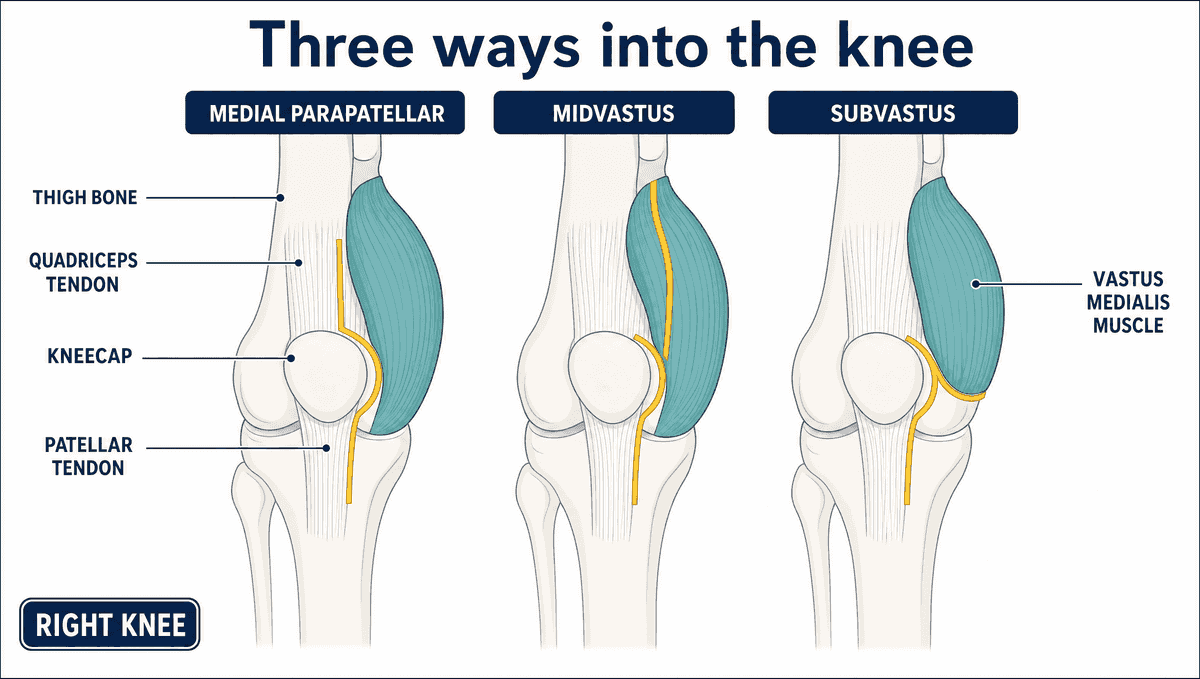
Medial parapatellar — the standard, and by a wide margin the most used. The incision continues along the inner edge of the quadriceps tendon, so the kneecap can be turned or slid aside. It cuts a portion of the tendon, which is then repaired.
Why it remains standard: it gives the best exposure of any approach, it works in a stiff knee, a large knee and a badly deformed knee, it can be extended if something unexpected is found, and it has the longest track record. When a knee is difficult, this is the approach that does not run out of room.
Subvastus — passes underneath the vastus medialis muscle and does not cut the quadriceps tendon at all. This is “quad-sparing” in the strict sense.
Midvastus — splits the fibres of the vastus medialis rather than going under it. A middle position: less tendon disruption than the standard approach, more exposure than the subvastus.
Lateral parapatellar — from the outer side, used for particular deformities, principally a significant knock-kneed (valgus) knee. Uncommon, and chosen for anatomy rather than preference.
What the evidence actually shows
The comparisons between the standard and muscle-sparing approaches have been done many times, and the pattern is consistent enough to summarise fairly:
- Small early advantages for the muscle-sparing approaches — an earlier straight leg raise, slightly less pain in the first weeks, slightly better early flexion
- Differences narrowing from about six weeks, and largely gone by three to six months
- No demonstrated difference in long-term function or implant survival
- Less exposure, which matters in a large, stiff or deformed knee, and a longer operation while a surgeon is learning the approach
- Not suitable for every knee — the subvastus approach in particular becomes difficult in a heavy thigh, a stiff knee or a revision
The honest reading of that: a reasonable option in a suitable knee, with a modest early benefit and no long-term one. Not a different category of operation, and not something to choose a surgeon for by itself.
What it also means is that a surgeon who uses the standard approach is not behind the times. The exposure it gives is a genuine clinical asset, and choosing it for a knee that needs it is a judgement rather than a habit.
”Quad-sparing” and the language problem
Here is the difficulty with the term: it is used two ways.
Precisely, it means an approach that does not cut the quadriceps tendon — the subvastus, essentially.
Loosely, it is applied to a standard medial parapatellar approach performed through a shorter skin incision. The tendon is still divided. Nothing has been spared except length of scar.
Both are advertised in the same words. If it is offered to you, the useful question is simply: which named approach do you mean? A clear answer names one of the four above.
The scar
Incision length gets more attention than it deserves, and total knee replacement covers why there is a floor below which the operation cannot be done — the components have to pass through.
Two things worth adding. A shorter scar achieved by retracting harder is not a gentler operation; the trauma has moved from the skin to the tissue underneath, where you cannot see it. And the length that suits your knee depends on the size of the knee, the deformity, the stiffness and how far the arthritis has progressed, which is why a fixed advertised number is a marketing decision rather than a surgical one.
The tourniquet
A tourniquet is an inflatable cuff around the upper thigh, inflated to stop blood flow during the operation.
For: a bloodless field, which improves visibility; and a dry, clean bone surface, which is genuinely relevant to how well cement keys into bone.
Against: it is implicated in thigh pain, quadriceps weakness and swelling in the early weeks, and some studies report earlier straight leg raise and less pain without it.
Where it sits: the evidence is mixed rather than settled, and practice has moved towards more selective use — many surgeons now inflate it only for the cementing part of the operation, or omit it. It is a fair question to ask, and there is no single right answer to expect.
Cemented, uncemented, and what else you will hear
Fixation. Cemented fixation is the standard for knee replacement in Australia and has the strongest registry record. Uncemented knees, which rely on bone growing into a textured surface, are used more selectively than in hips and mainly in younger patients with good bone. The registry is the reason cement remains the default: it is the option with the most evidence behind it, which is the argument that should win in an implant meant to last decades.
Cruciate-retaining or posterior-stabilised. An implant design decision rather than an approach — whether the posterior cruciate ligament is kept and the implant designed around it, or removed and its function replaced by the implant’s geometry. It is decided by the state of the ligaments and the deformity in your knee.
The kneecap. Whether the undersurface of the patella is resurfaced with a polyethylene button. Practice varies legitimately, though Australian practice has moved substantially towards resurfacing. Worth asking about.
What it is made of is covered separately in knee replacement materials and metal allergy.
Branded techniques
“Jiffy Knee”, “Nanoknee”, “Rapid Recovery”, “same-day knee replacement” and their relatives are trademarks applied to programmes, not distinct operations.
What is usually inside one:
- A muscle-sparing approach — often the subvastus
- A specific anaesthetic and pain-relief protocol, usually with nerve blocks and local infiltration
- An early, intensive physiotherapy pathway starting the day of surgery
- Careful patient selection — often younger, fitter, lighter patients with straightforward knees
That last point does most of the work, and it is the part least visible in the advertising. A programme that selects fit patients with uncomplicated knees will report quick recoveries, and it would report quick recoveries with a standard approach too.
None of this makes the programmes bad. The anaesthetic protocol and the rehabilitation pathway genuinely matter, and a practice organised around them is doing something useful. What is worth understanding is that the elements are available without the trademark, and that a branded name is not evidence of a better operation.
Patients researching knee replacement are, on the whole, right to be sceptical of marketing. Reading about knee replacement online covers the related problem of how to weigh what you find.
The questions worth asking
If you want to know what is actually planned for your knee:
- Which approach will you use, and why that one for my knee?
- Will you use a tourniquet?
- Cemented or uncemented, and why?
- Will the kneecap be resurfaced?
- What implant, and what does the Australian registry show for it?
- If something unexpected is found, what changes?
A surgeon who answers those directly is telling you more than any brochure. Answers that vary with the knee rather than being fixed in advance are a good sign rather than a hesitant one — the right approach for a stiff, deformed, heavy knee is not the right approach for a straightforward one, and a technique applied to every knee regardless is the thing actually worth questioning.
Next: Total knee replacement — or read about robotic assistance, which is a different question entirely.
What is a quad-sparing knee replacement?+
The term is used loosely, which is the main difficulty with it. Used precisely, it means an approach that enters the joint without cutting the quadriceps tendon — usually the subvastus approach, which passes underneath the vastus medialis muscle. Used loosely, it is applied to a standard approach performed through a shorter incision, which is not the same thing at all. If a quad-sparing technique is being offered, the question worth asking is which named approach is meant: subvastus, midvastus, or a standard medial parapatellar approach with a smaller skin incision.
Is the subvastus approach better than the standard approach?+
The published comparisons generally show small early advantages for the subvastus approach — an earlier straight leg raise, slightly less pain and slightly better flexion in the first weeks — with the differences narrowing and largely disappearing by around three to six months. Long-term function and implant survival appear similar. Against that, the subvastus approach gives less exposure, which matters in a large, stiff or significantly deformed knee, and it is not suitable for every patient. It is a reasonable option in the right knee rather than a straightforwardly better operation.
What is a Jiffy Knee or a Nanoknee?+
Trademarked names for knee replacement programmes rather than distinct operations. Each generally combines a muscle-sparing approach with a particular anaesthetic and pain-relief protocol, an early physiotherapy pathway, and careful patient selection. Most of what produces the quick recoveries these programmes advertise comes from the anaesthetic and rehabilitation pathway and from who is selected for it, rather than from a novel surgical technique. That is not a criticism of the programmes — those things genuinely matter — but it is worth knowing what you are being sold, and that the same elements are available without the trademark.
Is a tourniquet used in a knee replacement?+
Sometimes, and its use has become more selective. A tourniquet is an inflatable cuff on the upper thigh that stops blood flow to the leg, giving a bloodless field to work in and a dry bone surface for cement to key into. The argument against it is that it contributes to thigh pain, quadriceps weakness and swelling in the early weeks. The evidence is mixed rather than decisive, and practice varies between surgeons — many now use it for part of the operation rather than throughout, or omit it. It is a reasonable thing to ask about.
Cemented or uncemented — which is used for a knee replacement?+
Cemented fixation is the standard for knee replacement in Australia and has the longest and best registry record. Uncemented components, which rely on bone growing into a textured surface, are used more selectively in the knee than in the hip, and typically in younger patients with good bone quality. The choice is made on bone quality, age and the specific implant rather than on preference, and the registry data is the reason cement remains the default.
Does the length of the scar matter?+
Less than it is made to seem. The components have to pass through the incision, so there is a length below which the operation cannot be performed at all, and a short scar achieved by stretching the tissues harder is not a gentler operation. What is inside matters more than what is visible. A surgeon keeping the incision as short as the individual knee allows is doing the sensible thing; a surgeon advertising a particular number of centimetres is selling something.
Should the kneecap be resurfaced?+
It is one of the longest-running debates in knee surgery, and practice differs legitimately between surgeons and between countries. Resurfacing replaces the undersurface of the kneecap with a polyethylene button; not resurfacing leaves your own patella running on the new femoral component. Australian practice has moved substantially towards resurfacing, partly because persistent pain at the front of the knee is a common reason for further surgery when it is not done. Either position is defensible and it is a fair question to ask about at your consultation.