
Sleep After a Knee Replacement
Why sleep after a knee replacement is often worst around weeks four to six, when it settles, why the knee hurts more at night than during the day, a measured view of sleeping tablets, and what actually helps. By Perth orthopaedic surgeon Dr Rhys Clark.
Sleep is the most under-discussed part of a knee replacement and one of the most distressing. It rarely appears on a consent form, it is almost never raised in clinic, and it accounts for a large share of why the sixth week feels harder than the second.
This page is about the arc — why sleep gets worse before it gets better, and when it turns. For how to position the leg and set the bed up in the first fortnight, the first two weeks at home covers the practical side and is the better starting point if you have just come home.
The shape of it
Most people expect sleep to improve steadily as the knee improves. It does not, and the mismatch is the problem.
- Weeks 1 to 2. Broken, but you are exhausted enough to sleep through some of it. Two to four hours at a stretch is typical.
- Weeks 4 to 6. Usually the worst of it, and almost always a surprise, because the knee itself is clearly better than it was.
- Weeks 8 to 12. Improving, unevenly. Most people are getting one properly good night in three or four by the end of this stretch.
- Three to six months. Broadly normal nights, with the knee still able to produce a bad one after a heavy day.
- Six to twelve months. Back to your own baseline, whatever that was before the arthritis.
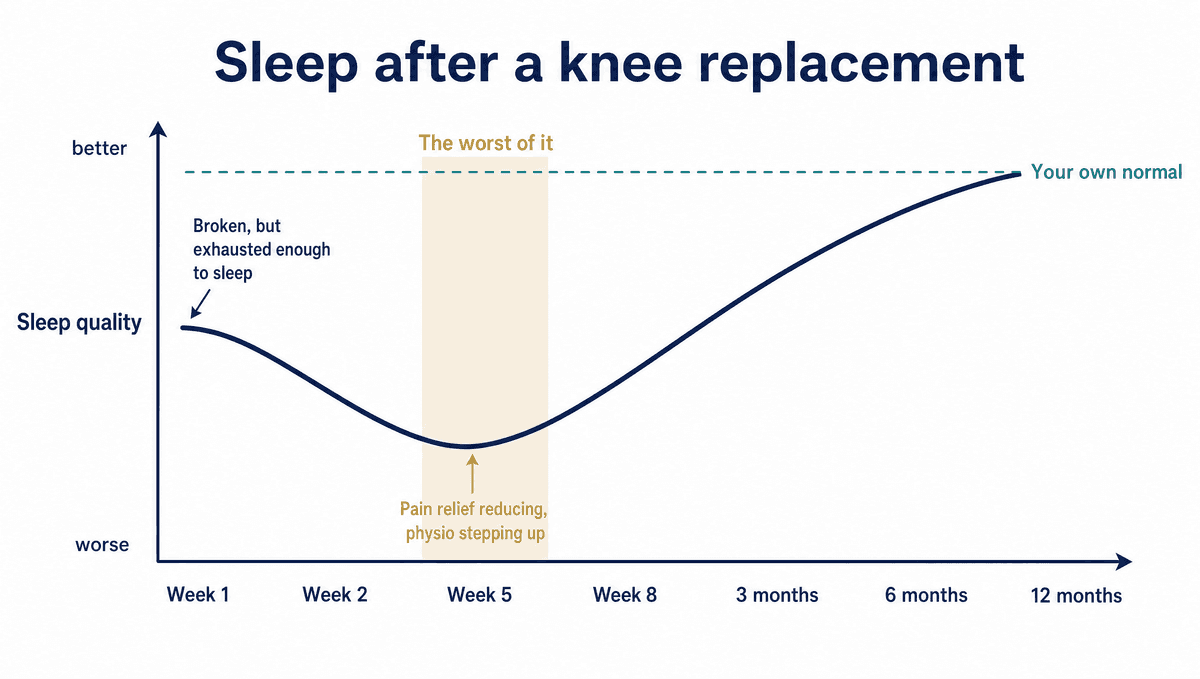
Those ranges are wide because people differ enormously here — more than they differ in range of movement or walking distance. Somebody sleeping through at four weeks is not doing better than you; they are sleeping differently, and they probably did before surgery too.
Why week five is the worst of it
Four things arrive at once, and none of them means the operation has gone wrong.
The strong pain relief is coming down. This is the largest factor and the least anticipated. Opioid medication suppresses deep sleep while you take it and disrupts sleep again while you come off it — a rebound that lasts one to two weeks and lands squarely in this window. Pain relief and coming off it sets out how the taper is managed; the sleep cost of the taper is real and temporary.
Physiotherapy has stepped up. The knee is being worked harder than at any point so far, and it responds by swelling more in the evening. A swollen knee is a tight knee, and a tight knee is worse lying still.
You are doing considerably more. The walking aid is going, the house is being navigated properly, and the leg is being asked for far more than it was a fortnight ago on strength it has not yet rebuilt.
The early exhaustion has gone. In the first fortnight the sheer physiological toll of surgery put you to sleep. By week five that has worn off and you are left with only the discomfort.
This stretch maps almost exactly onto the phase of recovery where progress feels like it has reversed. It is the same phenomenon seen from a different angle — knee replacement recovery describes the wider version.
Why the knee is worse at night
Not imagination, and worth understanding because understanding it takes some of the menace out of it.
- Nothing is competing. Pain with no distraction is measurably worse than the same pain during a busy day.
- Blood flow rises when you lie down and warm up. More flow into healing, inflamed tissue means more throbbing.
- Inflammation follows a daily rhythm that runs highest overnight and lowest in the late morning.
- Staying still stiffens the joint. Two hours without moving and the first movement genuinely hurts, which wakes you fully rather than half.
- The last dose is wearing off at around the time the other four are peaking.
The practical consequence is that the dose you take at nine o’clock is doing the wrong job. Timing the evening pain relief so its effect covers two to four in the morning — rather than the hour you go to bed — is the single most useful adjustment available, and it is worth asking specifically about at your review.
Sleeping tablets: a straight answer
This is asked constantly and answered vaguely, so:
It is a conversation for your GP, not a trip to the chemist. The specific concern is combining a sedative with opioid pain relief. Both suppress breathing, the effect is more than additive, and the weeks when you most want a sleeping tablet are the weeks you are still on the strongest medication.
Sedating antihistamines — the ones sold over the counter as sleep aids — are a poor choice for most people having a knee replacement. In older adults they cause confusion, dry mouth, urinary retention and falls, and a fall onto a new knee replacement is a genuinely bad outcome.
Benzodiazepines and Z-drugs work, and they work for a short time before tolerance and rebound insomnia set in. If one is prescribed, a short defined course with an end date is the sensible form.
Melatonin is the mildest option and the most reasonable one to ask about, particularly where the problem is getting to sleep rather than staying asleep. It is prescription-only in Australia for most formulations.
Alcohol is not a sleep aid. It shortens the time to fall asleep and wrecks the second half of the night, which is the half you are already losing. It also interacts badly with several of the medications you are likely taking.
What actually helps
In rough order of how much difference it makes:
- Time the evening dose to cover the small hours, not bedtime. Ask about this specifically.
- Ice before bed as routine, whether or not the knee hurts at that moment. Pre-empting the swelling beats chasing it.
- Move the leg before you settle. A dozen slow bends and straightens immediately before lying down leaves the knee less likely to seize.
- Get up and walk a lap rather than lying there when you wake stiff at 3am. Two minutes of movement resets it; two hours of lying still waiting does not.
- Keep the nap short and early. Twenty to thirty minutes after lunch. Not two hours at four o’clock.
- Get daylight into the morning, outside if you can manage it. Body clocks drift badly when several weeks are spent indoors, and morning light is the strongest correction available.
- Do something physical every day within what the knee allows. Under-activity is a common and unrecognised cause of poor sleep in this stretch.
- Keep the bed for sleeping. Several weeks of sitting in bed reading, eating and watching television teaches your body that bed is not for sleep. Sit in a chair during the day if you can get out of it safely.
When broken sleep is telling you something
Most of it is ordinary. These are the exceptions:
- Sleep getting worse at three months rather than better, particularly with a knee that is increasingly swollen, hot or painful. That warrants assessment rather than patience.
- Fever, chills or night sweats alongside a wound that is red, discharging or increasingly painful — phone the rooms, do not wait for the next appointment.
- Lying awake with your mind racing rather than with a sore knee. That is a mood symptom rather than a knee symptom, it is common at this stage of recovery, and it has its own answer — the emotional side of recovery covers it properly.
- A partner reporting heavy snoring or pauses in breathing. Weight change, deconditioning and opioid medication can unmask sleep apnoea that was previously borderline. Worth investigating rather than ignoring.
- Burning, electrical or crawling sensations keeping you awake rather than ordinary ache. Those respond to different medication entirely — see numbness, zaps and nerve pain.
The part worth holding on to
Sleep is a lagging indicator. It improves after the knee does, not alongside it, and the gap between the two is where people lose confidence in an operation that is in fact going perfectly well.
If you are six weeks out and sleeping badly, the most likely explanation is that you are six weeks out. It is worth saying out loud at your review anyway — the fixes are small, specific and usually available.
Next: Pain relief and coming off it — or the emotional side of recovery.
How long does sleep stay disrupted after a knee replacement?+
Longer than most people are told. Broken sleep is close to universal in the first fortnight, and it commonly gets worse rather than better through weeks four to six — which blindsides people, because the knee itself is improving by then. Most patients describe sleep settling substantially by around three months, and something close to their old pattern between six and twelve months. Being prepared for a bad middle stretch is most of what makes it bearable.
Why is sleep worse at five weeks than it was at two weeks?+
Several things coincide. The stronger pain relief that carried you through the early weeks is being reduced or stopped, and sleep often rebounds badly for a week or two afterwards. Physiotherapy is stepping up, so the knee is being worked harder and swells more in the evening. You are doing considerably more during the day on a leg that is not yet strong. And the early-weeks exhaustion that made sleep easy has worn off. It is a recognised pattern rather than a sign that something has gone wrong.
Why does my knee hurt more at night than during the day?+
Partly because there is nothing else competing for your attention, which is real rather than dismissive — pain with no distraction is genuinely worse. Beyond that: blood flow to the healing tissue increases when you lie down and warm up, inflammation follows a daily rhythm that peaks overnight, staying still for hours lets the knee stiffen so that every movement hurts, and the last dose of pain relief is usually wearing off in the small hours. The result is a knee that behaves worse at 3am than it did at 3pm.
Can I take sleeping tablets after a knee replacement?+
It is a reasonable conversation to have with your GP rather than something to start from the chemist. The specific caution is combining a sedative with opioid pain relief, because both suppress breathing and the combination carries more risk than either alone — this matters most in the weeks when you are still on stronger medication. Sedating antihistamines, widely sold as sleep aids, are a poor choice in older adults because of confusion, falls and urinary retention. Where a short course is genuinely warranted, short is the operative word.
Should I nap during the day if I have not slept at night?+
A short early-afternoon nap of twenty to thirty minutes is reasonable and does not meaningfully cost you that night's sleep. Long afternoon naps do, and a two-hour sleep at four in the afternoon is one of the most common self-inflicted causes of a bad night. In the first fortnight the body's demand for rest usually overrides this advice, and that is fine — it is from about week three onwards that nap discipline starts to matter.
Is it normal to sweat heavily at night after a knee replacement?+
Night sweats in the first weeks are commonly reported and usually reflect the body's inflammatory response to major surgery, sometimes with a contribution from opioid medication as it is reduced. What separates ordinary night sweats from something that needs attention is the company they keep: sweats with fever or chills, with a wound that is red, hot or discharging, or with pain that is escalating rather than easing, warrant a call to the rooms rather than a change of sheets.
When should broken sleep after a knee replacement be reported?+
When the pattern changes for the worse rather than slowly improving; when pain is waking you more often at three months than it did at six weeks; when sleep is broken by fever, sweats or a knee that is increasingly swollen and hot; when you are lying awake with your mind racing rather than with a sore knee, which points towards mood rather than the joint; or when a partner reports that you have started snoring heavily or stopping breathing. Each of those has a different answer, and none of them improves by waiting it out.