
Total Knee Replacement in Perth
Robotic-assisted total knee replacement in Perth by orthopaedic surgeon Dr Rhys Clark. Total knee arthroplasty for advanced knee osteoarthritis, with consulting rooms at Murdoch and Mandurah.

What’s involved?
Total knee replacement surgery (total knee arthroplasty) is a common treatment for osteoarthritis of the knee. Unlike a partial knee replacement, which resurfaces only the damaged compartment, a total knee replacement resurfaces the whole joint.
“The areas of damaged cartilage are removed from the end of the bone and replaced with metal and high-density polyethene (plastic),” explains Dr Rhys Clark.
Less bone comes out than most people expect — usually about 5 to 7 mm from the ends of the femur and tibia, rather than large sections of the thigh or shin bone. The cut ends are capped with a metal alloy, most often cobalt-chrome or titanium, and a high-density polyethylene insert sits between them so the two surfaces glide against each other rather than bone against bone. The undersurface of the kneecap is resurfaced with polyethylene as well. Bone cement is commonly used to fix the components in place.
Am I a candidate?
Your knee is made up of three compartments — the medial (inside), the lateral (outside), and the patellofemoral (kneecap). When two or more of these areas are damaged by osteoarthritis, a total knee replacement may be required.
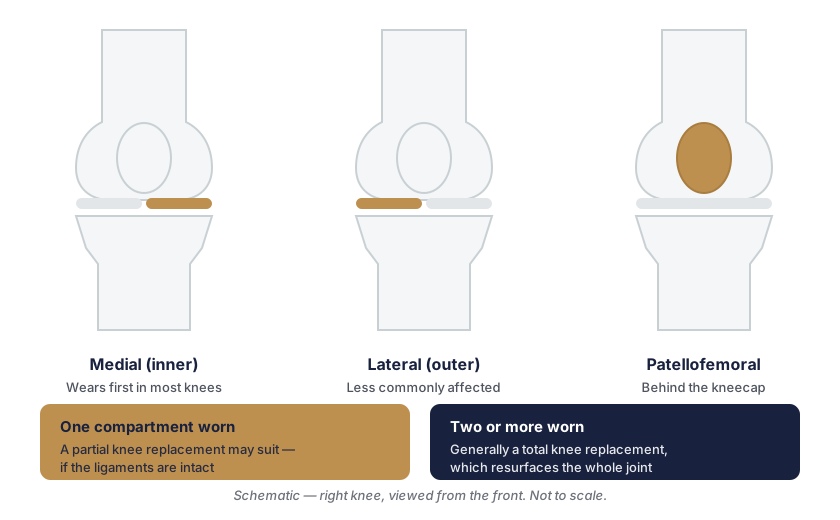
When osteoarthritis is at its worst, it can completely wear away your cartilage resulting in your bones rubbing against each other. This can mean a smaller range of movement and stiffness in your knee and can also cause issues such as bow-leg or knock-knee deformities. X-ray and CT/MRI imaging will be used to determine the extent of the damage in your knee. What a Knee Scan Actually Shows explains what each type of imaging contributes, and why a worn-looking film is not by itself a reason to operate.
“Once the cartilage in your knee becomes damaged it can cause you a considerable amount of pain. When that pain can’t be treated with medication, physiotherapy, and/or injections, a total knee replacement may be required.”
Robotic assistance and a virtual pre-op
Rhys uses robotic assistance in total knee replacement surgeries. While Rhys is still in control of the procedure, the robot assists in the bone preparation and placement of the implant. Where your surgery is planned on the Mako system you will have an additional CT scan beforehand, and those images let Rhys build a model of your knee and choose the correct size and position of your knee replacement. The VELYS system, which he also uses, is imageless and needs no planning scan.
“Before any surgery takes place, I use the images from your CT scan to complete a virtual pre-operation on a computer. When it comes to performing your surgery, the robotic arm helps guide me in making the bony cuts and implant placement.”
Robotic-assisted knee replacement covers this in full — what the robot does and does not do, how the CT planning works, and what the evidence currently supports.
Total knee replacements in Perth
Dr Clark performs robotic-assisted total knee replacements in Perth, with consultation and assessment at St John of God Medical Clinic in Murdoch and at the SJOG Consulting Rooms in Mandurah. Most private joint replacement surgery is performed at St John of God Murdoch; he also operates at Sir Charles Gairdner Hospital and Perth Children’s Hospital.
For Murdoch patients, the consulting rooms and the private operating hospital are on the same campus at 100 Murdoch Drive. For Mandurah and Peel patients, consultation, assessment, planning and post-operative review can happen locally in Mandurah, while the operation itself is performed in Perth.
Dr Clark performed 401 hip and knee replacements in 2025 and 357 in 2024 — more than 900 since January 2024 — of which approximately 60% are knee replacements. A further 60 revision procedures have been performed since January 2024.
Dr Clark uses both Mako and VELYS robotic systems for total knee replacement. Mako uses a CT scan before surgery to plan the implant size and position; VELYS is imageless and maps the knee in theatre. Which system is used depends on the hospital and theatre list, and determines whether a planning CT is needed.
Privately insured knee replacement patients are treated on a no-gap basis for Dr Clark’s surgical fee. Hospital, prosthesis, anaesthetic and assistant costs depend on your health fund and pathway, so the rooms provide details for informed financial consent before surgery. A GP referral is usually needed to claim the Medicare rebate for your specialist consultation.
When this is not the right operation
Not every arthritic knee needs replacing, and a worn X-ray on its own is not a reason to operate — arthritis shows on the films of more than half of people over 65, and only about one in seven of them have symptoms worth treating. What decides it is what the knee stops you doing.
There are also knees where a total replacement is the wrong answer rather than merely a premature one:
- Arthritis confined to one compartment, with intact cruciate ligaments, where a partial knee replacement preserves more of the knee
- Pain referred from the hip or the lower back, where the knee examines normally and the imaging does not match the symptoms
- A mechanical problem in a knee without much arthritis, which a smaller operation may address
- An undiagnosed inflammatory arthritis, which needs medical treatment rather than a joint replaced
When a Knee Replacement Is Not the Answer sets this out in full, including why two knees with matching X-rays can reasonably get different advice.
Minimally invasive surgery, and what limits it
Minimally invasive knee replacement comes up often in consultations, and it is worth being straight about what the term can and cannot mean. A knee replacement is a fixed size. The components have to pass through the incision, so below a certain length the operation cannot be done at all — the parts simply will not fit.
Within that limit, Rhys keeps each incision as short as the case allows. How short depends on the size of your knee, how far the arthritis has progressed, whether there is a deformity to correct, and how stiff the knee is beforehand.
The term is also used for a modified approach that changes how the surgeon enters the joint, with the aim of disturbing the quadriceps tendon less. It carries trade-offs rather than being straightforwardly better, and whether it suits your knee is a conversation for your consultation. How a knee replacement is done, and what gets marketed sets out the subvastus, midvastus and standard approaches, the tourniquet question, and how to read branded techniques such as Jiffy Knee and Nanoknee.
Your operation day
You will usually be admitted in the morning. The nursing staff will get you changed and work through the pre-operative checks. Rhys will see you in the holding area to answer any last questions and to mark the knee being operated on. The anaesthetist will introduce themselves and go through their own checks with you.
In theatre, a cannula goes into your arm for medication. The anaesthetic is usually a spinal block, given while you sit on the edge of the bed with your legs over the side, followed by sedation so that you are asleep for the operation. Once you are under, a nerve block with local anaesthetic is placed in the leg to control pain afterwards. The operation itself usually takes between one and one and a half hours, though you will be away from the ward for longer once preparation and recovery time are counted.
Afterwards your leg is bandaged and an ice pack applied to limit swelling. You go to the recovery room, where a nurse stays with you until you are fully awake, and then back to the ward.
The days in hospital
Because of the spinal anaesthetic, your legs will be numb for the first few hours. As it wears off the feeling returns and you will start to notice discomfort, which is managed with regular pain relief.
You will be asked to stand sooner than you might expect — weight bearing usually begins within about six hours of surgery. Moving early improves circulation, reduces the risk of blood clots, and leaves the knee less stiff than it would otherwise become. A physiotherapist will start you on exercises you can do from the bed on the first day.
By the morning after surgery most of the anaesthetic has worn off and pain is managed with tablets. The catheter comes out, you will shower and change into ordinary loose clothes, and Rhys prefers you to sit out in a chair for meals rather than staying in bed. An X-ray is taken to check the position of the components. The bulky bandaging is reduced, leaving the dressing applied in theatre, which normally stays on for about two weeks until your clinic review.
Physiotherapy continues daily until you go home. Work within your pain rather than pushing through it — before discharge the physiotherapist will want to see you moving about safely and managing stairs.
Most people stay two to four nights. Going home depends on four things: pain controlled with tablets, a dry dressing, a physiotherapist satisfied you are safe on your feet, and normal bladder and bowel function. Some patients transfer to a rehabilitation ward for extra physiotherapy first.
Going home
You will go home on crutches or a stick, with a prescription for pain relief to be taken regularly as directed rather than only when things get bad. Most people move to a single stick over the following weeks, and off the stick somewhere between four and six weeks depending on stability and confidence.
The main job in the first fortnight is to pace yourself. Keep to the physiotherapy you have been given rather than adding to it, and treat feeling better as a reason to keep going steadily rather than to do more. Rhys will see you at around two weeks to check the wound, review your pain relief and make sure you have enough medication. Physiotherapy usually steps up from around then.
“Total knee replacement surgery is one of the most rewarding operations I do,” shares Dr Clark.
If a knee replacement does give trouble later on, knee revision surgery is the operation that addresses it.
For a full week-by-week account of what to expect — the first fortnight at home, when driving becomes possible, and what the first year realistically looks like — see Knee Replacement Recovery. Common questions about the operation itself — how long it lasts, how long it takes, the MBS item number, driving and running — are answered on the total knee replacement FAQ. If you are weighing up whether a partial or total replacement fits your knee, Partial vs Total Knee Replacement explains how that decision is made. If you are still weighing the operation up, Understanding Knee Arthritis explains the condition in plain English and Do I Need a Knee Replacement? works through the decision itself.
How long does recovery take after a knee replacement?+
Most patients bear weight within hours of surgery and are discharged from hospital within a few days. A walking stick or crutches are usually needed for the first few weeks, and Dr Clark reviews you at around two weeks to check the wound and adjust pain management. Rehabilitation continues at home with physiotherapy.
Is the knee replacement robotic?+
Usually, yes — Dr Clark uses robotic assistance for total knee replacement on the Mako and VELYS systems, and it is part of how he performs the operation rather than an option billed separately. How the planning works, how the systems differ and what the evidence does and does not yet show is covered on [robotic knee replacement](/knee-replacement-surgery/robotic-knee-replacement/).
What is the knee replacement made of?+
The ends of the femur and tibia are capped with a strong metal alloy — usually cobalt-chrome or titanium — and a high-density polyethylene insert sits between them to allow smooth movement. The undersurface of the kneecap is also resurfaced with polyethylene. Bone cement is commonly used to fix the components in place.
How much bone is removed in a knee replacement?+
Less than most people expect. The procedure usually involves removing about 5 to 7 mm from the ends of the bones, rather than large sections of the thigh or shin bone.
What is the difference between a total and a partial knee replacement?+
The knee has three compartments — medial (inside), lateral (outside) and patellofemoral (kneecap). A partial knee replacement resurfaces only the damaged compartment. A total knee replacement replaces the whole joint surface and is generally used when two or more compartments are affected. Patients who have a total knee replacement are less likely to need further knee surgery later in life than those who have a partial replacement.
When is a total knee replacement not recommended?+
Most often when symptoms are still manageable — a worn X-ray in a knee that is not limiting you is not a reason to operate. It is also the wrong operation when arthritis is confined to a single compartment and a partial replacement would preserve more of the knee, when the pain is referred from the hip or lower back, or when an inflammatory arthritis has not yet been diagnosed and treated. Factors such as an active infection, poorly controlled diabetes or smoking are generally addressed before surgery rather than being permanent reasons against it.
Where does Dr Rhys Clark perform knee replacements in Perth?+
Dr Clark consults at St John of God Medical Clinic in Murdoch and at consulting rooms in Mandurah, and operates at St John of God Murdoch, Sir Charles Gairdner Hospital and Perth Children's Hospital.
Who performs robotic total knee replacement in Perth?+
Dr Rhys Clark is a Perth orthopaedic surgeon who performs robotic-assisted total knee replacement, using the Mako and VELYS systems. He consults at Murdoch and Mandurah, and most private joint replacement surgery is performed at St John of God Murdoch.
Is total knee replacement available at Murdoch?+
Yes. Dr Clark consults at St John of God Medical Clinic, Suite 10, 100 Murdoch Drive, Murdoch, on the same campus as St John of God Murdoch hospital. For many privately insured patients this means consultation, surgical planning, the operation and early follow-up are all on the same site.
Do I need a referral to see Dr Rhys Clark for knee replacement?+
A referral is usually required to claim the Medicare rebate for a specialist consultation. Most patients arrange this through their GP before booking.
Does Dr Clark offer no-gap knee replacement?+
Dr Clark works on a no-gap basis for privately insured knee replacement patients, matching his surgical fee to what the insurer pays. Hospital, prosthesis, anaesthetic and assistant costs still depend on the pathway and health fund, so patients should ask for informed financial consent before surgery.