
The Anaesthetic for a Knee Replacement
Spinal, general, sedation and nerve blocks for a knee replacement — what each one does, whether you will be awake, whether you will hear anything, how the choice is made and what the risks actually are. By Perth orthopaedic surgeon Dr Rhys Clark.
Of everything about a knee replacement, the anaesthetic is the part patients worry about most and ask about least. It sits outside the conversation with the surgeon, it involves a doctor most people do not meet until the morning of the operation, and the specific fear — will I be awake, will I hear anything — feels foolish to say out loud.
It is not foolish. It is the single most common question in patient support groups about knee replacement, and it deserves a straight answer.

The short answer
For a knee replacement you will not be awake, and you should not hear anything.
Most knee replacements in Australia are done under a spinal anaesthetic with sedation, usually with a nerve block as well. That combination of words causes most of the confusion, because “spinal” sounds like being awake and “block” sounds like being paralysed. Neither is what happens.
The three things, and what each one does
They are separate, they do different jobs, and most people have all three.
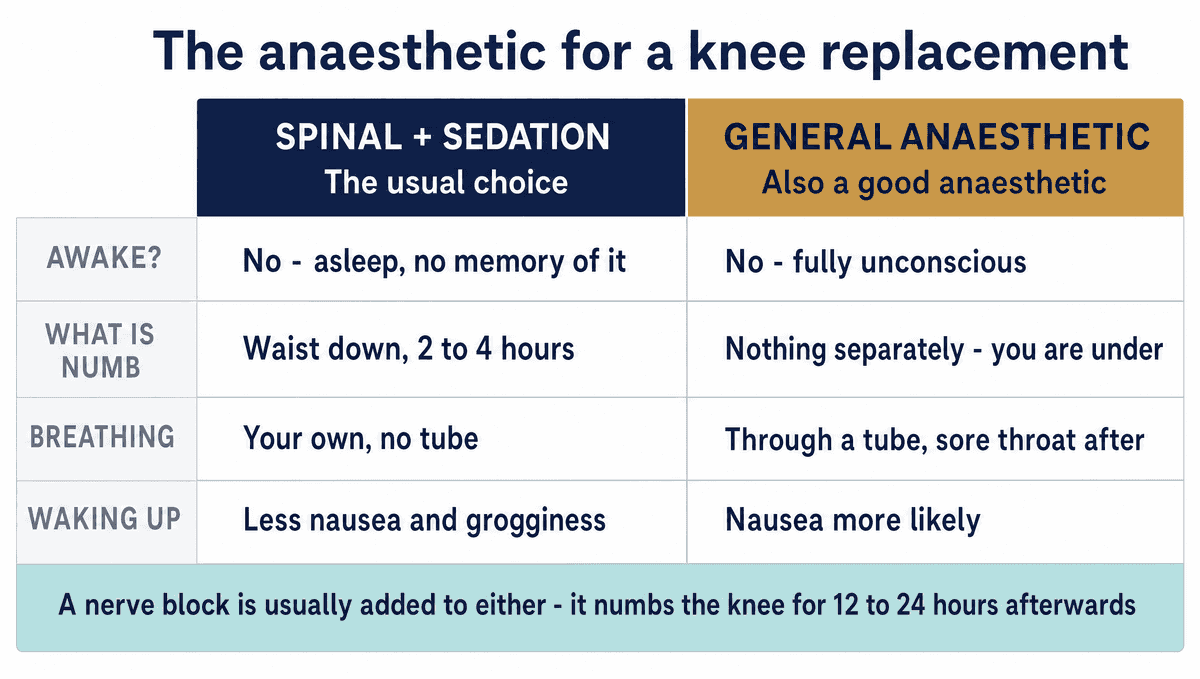
The spinal numbs you. A small injection of local anaesthetic into the lower back, below the level at which the spinal cord ends, which stops sensation from the waist down for roughly two to four hours. It is placed while you sit or lie on your side, after the skin has been numbed, and most people describe it as pressure rather than pain.
The sedation puts you to sleep. It runs through the drip in your hand and is the part people most often do not realise is there. It is why the answer to will I be awake is no.
The nerve block is for afterwards. Local anaesthetic placed around specific nerves, under ultrasound guidance, to keep the knee comfortable for the first twelve to twenty-four hours — the window in which pain is at its worst and tablets alone struggle.
A general anaesthetic is the fourth option and the one most people picture: consciousness fully suspended, a breathing tube placed, the anaesthetist controlling your breathing. It is used for knee replacement where a spinal is unsuitable or unwanted, and it is a perfectly good way to have the operation.
“Will I hear the surgeon?”
No.
The worry is specific and almost always unspoken: that a spinal means lying awake behind a drape listening to instruments. Some operations are done that way. A joint replacement is not one of them. The sedation is set at a depth where you are asleep and do not form memories, and the usual report afterwards is of being wheeled in and then waking up in recovery with it over.
If you have ever been more aware than you expected during a previous procedure — a colonoscopy, a dental sedation, a caesarean — tell the anaesthetist. It genuinely changes how they manage the sedation, and it is information they cannot get any other way.
Why a spinal is usually chosen
Not because a general anaesthetic is dangerous. Because of a set of practical advantages that add up over the first day:
- Less nausea and less grogginess on waking, which matters more than it sounds — the sooner you can eat, drink and sit up, the sooner everything else starts
- No breathing tube, and so no sore throat
- The airway is not instrumented, which is relevant if you have a difficult airway, sleep apnoea or significant lung disease
- It works with the nerve block to reduce how much opioid medication is needed in the first day, which in turn reduces nausea, constipation and confusion
- Less blood loss during the operation itself
The differences between the two techniques in serious complications are small, and anyone who tells you a spinal is dramatically safer is overstating it. What is fair to say is that for a knee replacement in a person who is often in their sixties or seventies, the first-day experience is generally smoother.
When a general anaesthetic is used instead
Regularly, and it is not a second-best outcome. The usual reasons:
- A spine that will not accept the needle — previous fusion or instrumentation, severe scoliosis, or significant arthritis of the lumbar spine
- Blood thinners that cannot safely be stopped for long enough
- An infection in the skin of the lower back
- Certain heart conditions, where the drop in blood pressure a spinal can cause is better avoided
- A previous bad experience with a spinal, or simply a strong preference. This counts, and you do not need a medical reason for it
The anaesthetist is a separate specialist
Worth understanding, because it surprises people: your anaesthetist is not an assistant to the surgeon. They are a specialist in their own right, with their own fellowship training, their own consent conversation with you and their own bill.
Dr Clark’s joint replacement lists are staffed by a regular group of specialist anaesthetists — Dr Peter Garnett, Dr Owen Gray and Dr Michael Truelove — rather than by whoever is rostered on. The practical benefit is a consistent approach to pain relief after a knee replacement across the list, which is the part of the anaesthetic that most affects how the first week goes.
You will meet your anaesthetist before the operation, either at pre-admission or on the morning. That is the conversation in which the technique is decided, and it is the right place to raise anything on this page.
What they will ask, and what to bring
The pre-anaesthetic conversation covers the same ground every time. Being ready for it makes it a better conversation:
- Every medication you take, including things you would not think of as medication — fish oil, turmeric, herbal preparations, over-the-counter anti-inflammatories
- Blood thinners specifically, and who prescribes them
- Diabetes medication, including whether you take a GLP-1 medication such as Ozempic — these affect fasting instructions and are worth flagging early. Ozempic and knee replacement surgery covers why
- Previous anaesthetics — anything that went badly, severe nausea afterwards, difficulty waking, or awareness
- Family history of anaesthetic problems, which occasionally matters a great deal
- Sleep apnoea, whether or not you use a CPAP machine
- Loose teeth, caps or crowns, and whether you have dentures
- Reflux, which affects how the airway is managed
The risks, stated plainly
Every anaesthetic carries risk, and the honest position is that for a fit person the serious risks are small while the minor ones are common.
Common and temporary: nausea, shivering, a sore throat after a general, temporary difficulty passing urine after a spinal (occasionally needing a catheter for a day), and a patch of numbness around the knee that has nothing to do with the anaesthetic and everything to do with the incision — numbness and nerve symptoms covers that separately.
Uncommon: headache after a spinal, which is treatable and usually settles; a nerve block that lasts longer than expected; a reaction to a drug.
Rare: permanent nerve injury from a spinal or a block, and serious cardiac or respiratory events. These are rare enough that they are counted in large national datasets rather than encountered in ordinary practice, which is precisely why the pre-anaesthetic assessment is thorough.
Worth naming, because it worries families: a period of confusion in the days after surgery, more likely with age and in anyone with existing memory problems. It is usually temporary. It is also one of the reasons the anaesthetic is built around a spinal and a block rather than around opioids — pain relief after a knee replacement explains how the layers fit together.
What it costs
The anaesthetist bills separately from the surgeon and the hospital, and you should receive an estimate in advance. If you have not, ask — informed financial consent is a requirement, not a courtesy. What a knee replacement costs sets out the whole picture, including which parts have a gap and which do not.
The thing worth saying
Patients who arrive frightened of the anaesthetic are often the ones who say afterwards that it was the easiest part of the whole experience. That is a genuine pattern, and it is worth knowing in advance — as is the corollary, which is that the difficulty of a knee replacement lies in the weeks afterwards rather than in the hour itself.
If any of this is worrying you, raise it. It is a five-minute conversation that reliably solves a problem people otherwise carry for months.
Next: Preparing for a knee replacement — or read about what happens on the day and afterwards.
Will I be awake during a knee replacement?+
No. Where a spinal anaesthetic is used it is combined with sedation given through the drip, and the depth of that sedation is set so that you are asleep for the operation and have no memory of it afterwards. People often expect a spinal to mean lying awake behind a screen listening to theatre; that is not how a joint replacement is ordinarily done. If being aware of any part of it worries you, say so before the day — the sedation can be deepened, and a general anaesthetic remains available.
Is a spinal or a general anaesthetic better for a knee replacement?+
A spinal with sedation is the more common choice for joint replacement in Australia, and the practical reasons are that nausea and grogginess afterwards tend to be less, the airway is not instrumented so there is no sore throat, and the same needle placement allows medication that continues working into the first hours after surgery. The differences in serious complications between the two are small, and a general anaesthetic is a perfectly good anaesthetic for a knee replacement. The right answer depends on your spine, your medications and your own preference, and it is the anaesthetist's decision to make with you.
Will I hear anything during the operation?+
You should not, and this is worth raising directly rather than worrying about privately. Sedation for a knee replacement is not intended to leave you listening to the room. If you have had a procedure before where you were more aware than you expected, tell the anaesthetist — it changes how the sedation is managed.
What is a nerve block, and will my leg be dead weight afterwards?+
A nerve block is local anaesthetic placed around specific nerves to numb the knee for the first twelve to twenty-four hours. The block used for knee replacement is generally chosen to numb sensation while leaving the thigh muscle working, because the ability to lift and control the leg is what allows you to stand and walk on the day of surgery. Some heaviness is normal; a leg that will not move at all is not expected and should be mentioned to the nursing staff.
Can I have a knee replacement if I have had back surgery or a spinal fusion?+
Often yes, but not always, and it is one of the specific things to raise at your pre-admission appointment. Previous fusion, significant scoliosis or spinal instrumentation can make a spinal anaesthetic difficult or impossible to place, in which case a general anaesthetic is used instead. Bring any spinal imaging or operation reports you have.
Do blood thinners need to stop before a knee replacement?+
Usually, and the timing depends on which medication and why you take it — a decision made by the anaesthetist and your prescribing doctor rather than by you. It matters particularly for a spinal anaesthetic, because the injection cannot safely be performed while the blood is fully thinned. Bring a complete list of everything you take, including over-the-counter medication, fish oil and anything herbal.
I am worried about confusion after the anaesthetic. Is that common in older patients?+
A period of confusion in the days after major surgery is recognised, more likely with increasing age and in people who already have memory difficulties, and it is usually temporary. It is one of the reasons the anaesthetic for a joint replacement is generally designed around a spinal with the lightest workable sedation, and why pain relief is layered rather than relying heavily on opioids. If a relative has been confused after previous surgery, say so — it changes the plan.