
Knee Replacement Materials, Metal Allergy and Bone Cement
What a knee replacement is actually made of, whether a nickel or metal allergy matters, why patch testing is a poor guide, what bone cement is and what a cement reaction really means, and what the alternatives are. By Perth orthopaedic surgeon Dr Rhys Clark.
This page answers two questions that are usually asked together: what is actually going inside my knee, and could I react to it.
The second is asked more often than most surgeons realise, usually by people who cannot wear cheap earrings and have spent an evening online arriving somewhere alarming.
What a knee replacement is made of
Three materials, doing three jobs.
The femoral component — the piece that caps the end of the thigh bone — is a metal alloy, most commonly cobalt-chromium. It also contains nickel and molybdenum. It is polished to a mirror finish, because it is the surface that slides.
The tibial component — the tray on top of the shin bone — is usually titanium alloy or cobalt-chromium.
The bearing is a high-density polyethylene insert that clips into the tibial tray and sits between the two metal pieces. This is the part that wears, and it is where most implant engineering effort has gone over the last thirty years: modern polyethylene is cross-linked, sometimes with vitamin E added, to reduce wear.
The patella, where it is resurfaced, is a polyethylene button on the undersurface of the kneecap.
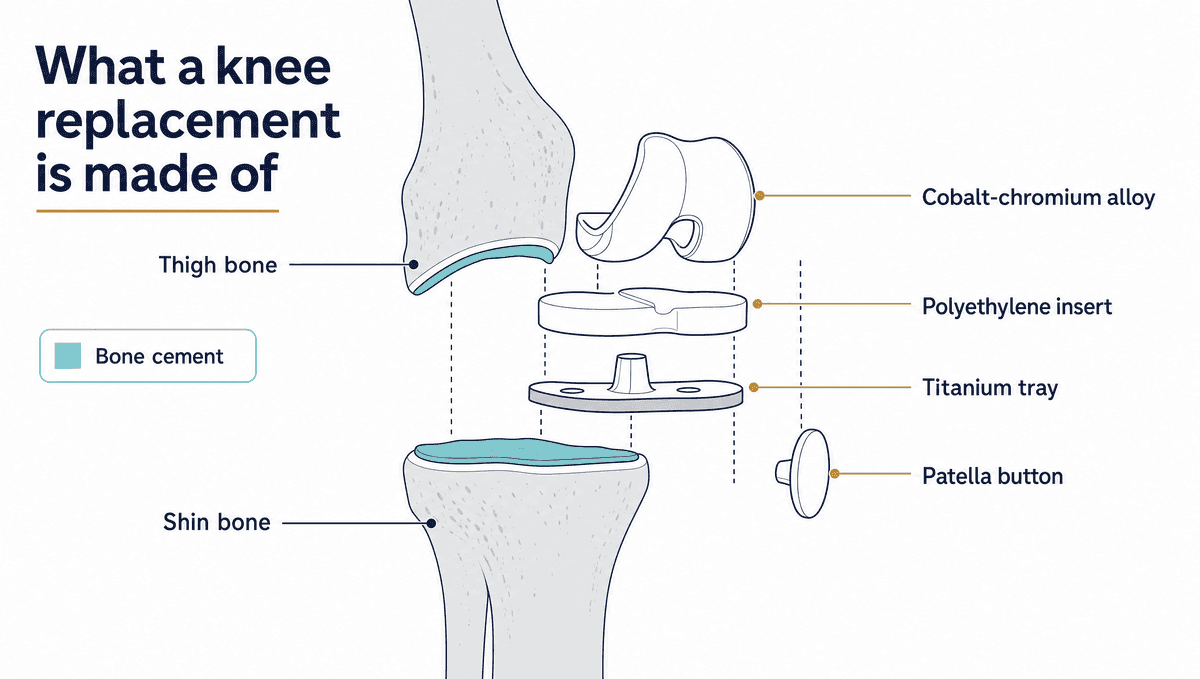
Bone cement fixes the components to bone in most knee replacements. It is polymethylmethacrylate — an acrylic, chemically related to Perspex — mixed in theatre, usually containing an antibiotic and an agent that makes it visible on X-ray. It sets in minutes and grips mechanically rather than gluing.
None of this is exotic. These material choices have been broadly stable for decades, which is the main reason the long-term data on them is as good as it is.
Why those materials
Because they solve the problem, which is harder than it sounds: a surface has to slide against another surface several million times without wearing out, while carrying several times body weight, inside a warm salt-water environment that corrodes most things, and without the body attacking it.
Cobalt-chromium is hard, takes and holds a polish, and resists corrosion. Polyethylene is tough, low-friction and slightly forgiving. Titanium is lighter, flexes closer to the way bone does and bonds well where an uncemented fixation is wanted. Most improvements in the last twenty years have come from making the polyethylene wear less, not from changing the metals.
The allergy question
Here is the honest position, stated plainly because the online material on this is poor in both directions.
Metal allergy on the skin is common. Nickel contact dermatitis affects a substantial minority of women and a smaller proportion of men. It is why watch backs, belt buckles and earrings cause trouble.
Problems attributed to implant metal are rare. Millions of knee replacements have been performed in people who react to jewellery, and the overwhelming majority are uneventful.
The two are not the same thing. The skin and the tissue around a joint handle metal exposure differently, and a positive skin reaction has never been shown to predict how a knee replacement will behave.
There is no reliable test. This is the crux of it. Patch testing measures the skin. The lymphocyte transformation test is not validated for deciding implant choice. Both throw up positives in people whose knees go on to be entirely fine. A test that cannot separate the people who will have a problem from the people who will not cannot be used to make the decision.
So it is a diagnosis of exclusion. A knee replacement that hurts is far more likely to hurt for one of the ordinary reasons, and those are investigated first — when a knee replacement still hurts sets out that sequence. Infection in particular must be excluded, because it presents similarly and is treated completely differently. Hypersensitivity is what is left when the list is genuinely exhausted, not where the list begins.
What this does not mean is that you should keep quiet about it. It means the conversation belongs before surgery, in the rooms, with whatever documentation you have — not in a forum, and not on the morning of the operation.
Bone cement: two different things with similar names
Worth separating, because they get conflated and one of them sounds much worse than it is.
Allergy to the cement itself is rare. Where a genuine acrylic sensitivity is documented — occasionally in dental technicians, nail technicians and others with heavy occupational exposure — it is worth flagging, and uncemented fixation is a possibility.
Bone cement implantation syndrome is not an allergy. It is a transient drop in blood pressure and oxygen at the moment cement is pressurised into bone, caused by material entering the circulation. It is a recognised anaesthetic event, it is anticipated and managed in theatre, and it is considerably more relevant to hip replacement than to knee replacement. Your anaesthetist will be alert to it; the anaesthetic for a knee replacement covers the rest of their side of the operation.
The alternatives, and what they cost you
Options exist for reducing metal exposure. They are genuine, and they involve trade-offs worth understanding:
- Ceramicised or ceramic-coated bearing surfaces — oxidised zirconium and similar. The bearing surface presents ceramic rather than metal alloy to the joint. Used where a real concern exists.
- Titanium-nitride coated implants — a hard coating over a standard alloy component.
- All-polyethylene tibial components — removes the metal tray entirely. Long-established, with good registry performance in the right patient.
- Uncemented fixation, where cement rather than metal is the concern.
The trade-off is not usually safety. It is evidence. Some of these options have a shorter registry track record than the standard combination, which matters when you are choosing something intended to last decades. Availability and cost also vary between hospitals and health funds.
The reasonable position: where there is a documented, significant allergy, an alternative is a sensible choice and the slightly thinner evidence base is a price worth paying. Where there is a history of itchy earrings and no other problem, choosing a less-proven implant to solve a problem that probably is not there is the worse decision of the two.
What to do if this applies to you
- Raise it at the consultation, not at pre-admission and not on the day. Implants are ordered in advance.
- Bring documentation if you have it — a patch test result, a dermatologist’s letter, a record of a previous implant that caused trouble.
- Say what actually happened. “A rash under my watch” and “my hip replacement had to come out” are different histories leading to different decisions.
- Ask what is planned and why. You are entitled to know which implant is intended, what it is made of, and what the alternative would be.
- Keep the record afterwards. Your operation report names the implant, and every joint replacement in Australia is recorded with the national joint replacement registry. Keep a copy somewhere you can find it.
The registry, briefly
Australia runs one of the most complete joint replacement registries in the world. Every hip and knee replacement performed here is recorded, and each implant’s performance is tracked over time and published annually.
This is worth knowing for two reasons. It is why questions like how long does this implant last have real answers in this country rather than manufacturer estimates. And it is why implant choice is a conservative business: an implant with fifteen years of registry data behind it is a different proposition from one released last year, however good the brochure.
Next: Total knee replacement — or read about how the knee is opened and what gets marketed.
What is a knee replacement made of?+
Three materials do nearly all the work. The end of the thigh bone is capped with a metal alloy, most commonly cobalt-chromium, which also contains nickel and molybdenum. The top of the shin bone carries a metal tray, usually titanium alloy or cobalt-chromium. Between them sits an insert of high-density polyethylene, a very hard-wearing medical-grade plastic, which is the surface the joint actually moves on. Where the kneecap is resurfaced it is with a polyethylene button. Most components are fixed with bone cement, which is an acrylic — polymethylmethacrylate — usually containing an antibiotic.
Can you be allergic to a knee replacement?+
True hypersensitivity to a joint replacement is uncommon and genuinely difficult to prove, which is a different statement from saying it does not exist. The difficulty is that there is no test that reliably distinguishes a person whose implant is causing an immune reaction from a person who has a painful knee for one of the far more common reasons. Because of that, it is treated as a diagnosis of exclusion: infection, loosening, instability and soft tissue causes are investigated and ruled out before hypersensitivity is seriously entertained.
I react to cheap jewellery. Does that mean I will react to a knee replacement?+
Probably not. Nickel contact dermatitis is common — it affects a substantial minority of women and a smaller proportion of men — while problems attributed to implant metal are rare, so most people with a jewellery reaction have an uneventful knee replacement. The skin and the tissue around a joint behave differently immunologically, and a positive skin reaction has not been shown to predict how an implant will perform. It is still worth mentioning before surgery, because it is part of the conversation about which implant to use.
Should I have patch testing before a knee replacement?+
It is not routinely recommended, and the reason is that it answers a different question from the one being asked. Patch testing measures a skin response. It produces positive results in many people who go on to have entirely uneventful joint replacements, and it cannot be relied on to predict a problem at the implant. Where there is a strong, well-documented history — a severe reaction, or a previous implant elsewhere that caused trouble — dermatology assessment before surgery is reasonable, and the result informs the discussion rather than deciding it.
What is bone cement, and can you be allergic to it?+
Bone cement is polymethylmethacrylate, an acrylic that is mixed in theatre and sets within minutes, gripping the implant to the bone. It usually contains an antibiotic and a radio-opaque agent so it shows on X-ray. Genuine allergy to the cement itself is rare. What is more often meant by a cement reaction is bone cement implantation syndrome, which is not an allergy at all but a drop in blood pressure and oxygen levels at the moment the cement is inserted — an anaesthetic event, recognised, managed in theatre, and more relevant in hip surgery than in knee surgery.
Are there nickel-free or hypoallergenic knee replacements?+
There are alternatives with reduced metal exposure — ceramic-coated or ceramicised metal bearing surfaces, titanium-nitride coatings, and all-polyethylene tibial components which remove one metal part entirely. They are real options and they are used where there is a genuine reason. The trade-off is that some have less long-term registry data behind them than the standard components, and availability and cost vary. The sensible approach is to raise a documented allergy well before the date so the choice can be made properly rather than on the morning.
How do I find out which implant was used in my knee?+
Ask, and you are entitled to know. The implant details — manufacturer, type and sizes — are recorded in your operation report, and in Australia every joint replacement is also recorded with the Australian Orthopaedic Association National Joint Replacement Registry, which tracks how each implant performs over time. Keep a copy: it matters if you ever need further surgery, and it is one of the first things another surgeon will ask for.