
Is It Knee Arthritis, or Something Else?
Osteoarthritis, inflammatory arthritis, a meniscus tear, gout or bursitis — what separates them, why the difference changes the treatment entirely, and what to mention at your appointment.
“Arthritis” is the label a knee usually gets once it has hurt for a while, and most of the time it is the right one. But several other things produce pain in the same place, and a few of them are treated in completely different ways — some urgently.
This page covers what separates them. It will not diagnose your knee, and it is not meant to. It is meant to help you describe it accurately, because the details that distinguish these conditions are things only you can report.
Osteoarthritis, and what it looks like
Osteoarthritis is wear of the cartilage that lines the joint. The pattern is characteristic enough that it is usually recognisable from the history alone:
- It builds over months or years, not days
- It is worse the longer you are on your feet, and eases with rest
- Morning stiffness loosens within about half an hour
- It affects one or two large joints — a knee, perhaps a hip — not many at once
- Swelling comes and goes
- You feel well in yourself
If that describes your knee, Understanding Knee Arthritis covers the condition properly, and Treating Knee Arthritis Without Surgery covers what the evidence supports.
Inflammatory arthritis
This is the distinction that matters most, because it changes who should be treating you.
In rheumatoid arthritis and related conditions, the immune system inflames the joint lining. It is not wear, and it does not respond to the things that help osteoarthritis. It needs medical treatment — and starting that treatment early meaningfully changes how the disease progresses, which is why it is worth recognising rather than assuming any painful joint is wear and tear.
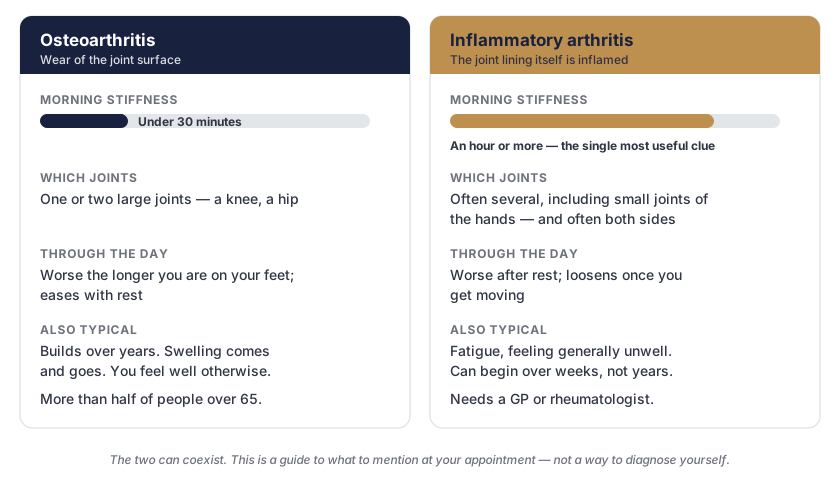
The single most useful question is about morning stiffness. Under thirty minutes points towards osteoarthritis. An hour or more, most mornings, points away from it — and is worth a GP appointment and a blood test rather than a wait-and-see.
The other prompts: several joints at once, the small joints of the hands, symmetry between left and right, fatigue, or feeling generally unwell alongside the joint pain.
The two are not mutually exclusive. Someone with long-standing rheumatoid arthritis can also develop wear in a knee, and a knee replacement is sometimes the right operation for an inflamed joint. The point is not to sort yourself into one box — it is to make sure inflammatory disease is not being managed as though it were wear.
A meniscus tear
The menisci are two C-shaped cartilage cushions sitting between the thigh bone and the shin bone. A tear is felt in much the same place as medial compartment arthritis, which is why the two are so often confused.
What separates them is usually the beginning and the behaviour:
| Arthritis | Meniscus tear | |
|---|---|---|
| How it started | Gradually, over months or years | Often a twist, squat or awkward step |
| What it does | Aches with time on your feet | Catches, clicks, or gives way |
| Swelling | Comes and goes over months | Often within a day of the incident |
| Worst moment | End of a long day | A specific movement |
The complication is that after about fifty, the two commonly occur together — and a tear reported on a scan is frequently a feature of the arthritis rather than a separate problem. This distinction has real consequences. Knee arthroscopy for a degenerate tear in an arthritic knee generally does not help, and the evidence on that is now reasonably settled. For a genuine mechanical tear in a knee without much arthritis, it can help a great deal. Telling those two situations apart is most of the work.
Meniscus Tear covers the condition in full.
Gout and infection
Both produce a knee that becomes painful, hot and swollen rapidly — over hours, not weeks — usually without an injury to explain it.
Gout is caused by urate crystals forming in the joint. Septic arthritis is an infection inside it. From the outside they can look very similar, and the difference matters enormously, because an infected joint damages quickly and needs urgent treatment.
A knee that becomes hot, very swollen and severely painful over hours — especially with fever, shivering, or feeling unwell — needs same-day medical assessment. Do not wait for a specialist appointment. Sampling the fluid from the joint is what settles the question.
Tendon and bursa problems
These sit outside the joint rather than inside it, and they are usually tender in a small, specific spot you can point to with one finger:
- Patellar or quadriceps tendinopathy — below or above the kneecap, activity-related, common in active people
- Prepatellar bursitis — swelling directly over the kneecap, common in people who kneel for work
- Pes anserine bursitis — a small tender area just below the joint line on the inner side
- Iliotibial band syndrome — outer side, comes on predictably after a set distance in runners and cyclists
They tend to respond to load management and physiotherapy rather than anything done inside the joint.
Pain that is not coming from the knee
Worth knowing about, because it is missed regularly.
Hip arthritis most often causes groin pain, but it can refer down the front of the thigh to the knee — and occasionally a person presents with knee pain and nothing else, with a hip that turns out to be the problem. Understanding Hip Arthritis covers that pattern.
The lower back can refer pain below the knee through nerve irritation, usually with some back symptoms and sometimes with pins and needles or weakness.
A knee that hurts, examines normally and has a normal X-ray is a strong prompt to look above it.
What this means for your appointment
The examination and the imaging matter, but the history is what usually makes the diagnosis. The details worth having ready:
- When it started, and whether there was a specific incident
- How long morning stiffness lasts — the single most useful number
- What makes it worse, and what settles it
- Whether other joints are involved
- Whether the knee catches, locks or gives way
- What your walking distance was a year ago, compared with now
- Anything else going on — fevers, fatigue, rashes, weight loss
If imaging has already been arranged, or you have been told you need a scan, What Knee Scans Actually Show explains what each type can and cannot answer — including why a scan finding does not always explain the pain.
If the location of your pain is the thing you are trying to make sense of, Where Your Knee Hurts works through it region by region.
This page is general information about conditions that cause knee pain. It cannot tell you which one you have — that requires an examination, and sometimes imaging or blood tests. If your knee becomes suddenly and severely painful, hot or swollen, or you feel unwell with it, contact your doctor the same day.
Appointments can be made on (08) 6332 6365 or through the contact page. A GP referral is usually needed to claim the Medicare rebate for a specialist consultation.
How do I know if my knee pain is arthritis?+
The pattern is usually more telling than the pain itself. Osteoarthritis builds over months or years, is worse the longer you are on your feet, eases with rest, and produces morning stiffness that loosens within about half an hour. It typically affects one or two large joints rather than many, and you feel well in yourself otherwise. Pain that arrived suddenly, stiffness lasting more than an hour, or several joints involved at once all point somewhere else and are worth raising with your GP.
What is the difference between osteoarthritis and rheumatoid arthritis in the knee?+
Osteoarthritis is wear of the joint surface — a mechanical problem in one or two joints, worse with use. Rheumatoid arthritis is a disease in which the immune system inflames the joint lining, usually affecting several joints including the small joints of the hands, often on both sides, with morning stiffness lasting an hour or more and frequently with fatigue or feeling generally unwell. The treatments are entirely different: rheumatoid arthritis needs medical treatment from a GP and rheumatologist, and the earlier it starts the better.
Is it arthritis or a meniscus tear?+
They are felt in much the same place and frequently occur together. A meniscus tear more often has a beginning — a twist, a deep squat, an awkward step — and tends to catch, click or give way. Arthritis builds gradually and is dominated by how long you have been on your feet. After about 50 a tear found on a scan is often part of the arthritis rather than a separate problem, which matters because arthroscopic surgery for a degenerate tear in an arthritic knee generally does not help.
Could my knee pain be gout?+
It can be. Gout in the knee usually comes on rapidly — over hours rather than days — and produces a joint that is intensely painful, hot, red and swollen, often without any injury. It can be difficult to distinguish from infection, which is why a hot, swollen knee needs same-day assessment rather than waiting. Sampling the joint fluid settles it.
Can knee pain come from the hip or the back?+
Yes, and it is missed more often than you would expect. Hip arthritis classically produces groin pain, but it can refer to the front of the thigh and the knee, and some people present with knee pain alone. Nerve irritation in the lower back can also be felt below the knee. A knee that hurts but examines normally, with a normal X-ray, is a prompt to look at the hip and the spine.
Does a normal X-ray mean my knee is fine?+
No. An X-ray shows bone well and cartilage only indirectly, so early cartilage damage, meniscus tears, ligament injuries and tendon problems can all be present with a normal-looking film. Equally, an abnormal X-ray does not prove the arthritis is what is hurting — it shows on the films of more than half of people over 65, many of whom have no symptoms.