
When a Knee Replacement Is Not the Answer
The situations in which a Perth knee surgeon advises against a knee replacement — too early, the wrong problem, pain coming from elsewhere, and factors worth addressing first. Why two knees with identical X-rays can get different advice.
Most pages about knee replacement explain when to have one. This one covers the other half of the conversation, which comes up in clinic just as often: the reasons not to, or not yet.
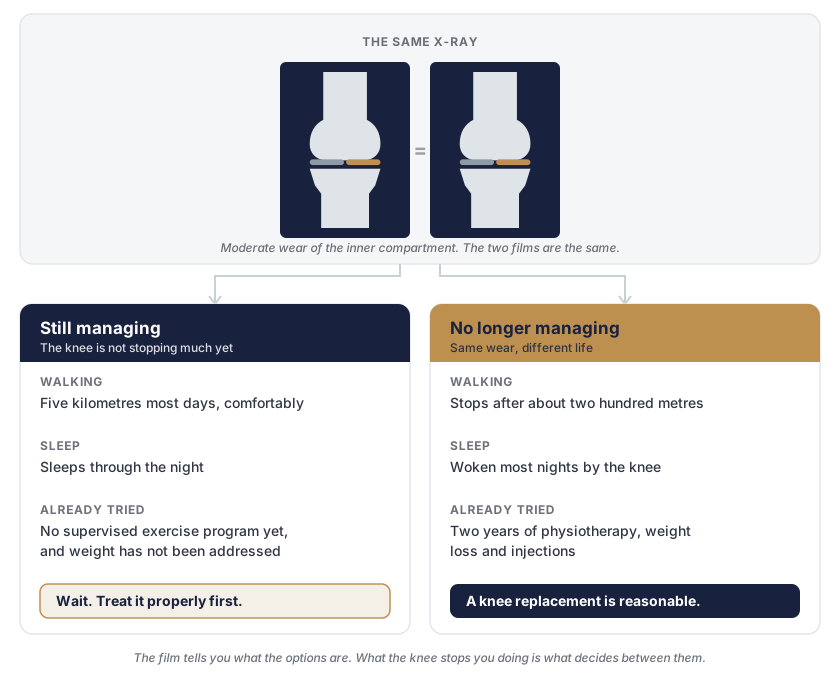
It is worth writing down because the decision is frequently presented as though the X-ray makes it. It does not. Two people can arrive with films that look the same and leave with different advice, and the reasons why are not mysterious — they are just rarely explained.
The X-ray is not the decision
Arthritis shows on the X-rays of more than half of people over 65, and only about one in seven of them have symptoms worth treating. A worn film in a knee that is not limiting you is not a reason to operate.
What the imaging establishes is what the options are — which compartments are worn, what the alignment is doing, what the ligaments are doing. That determines whether a partial replacement is possible, or whether a total is the realistic choice. It does not determine whether an operation should happen at all.
That question is answered by what the knee stops you doing.
When I advise waiting
The symptoms are still manageable. If you are walking the distances you want to walk, sleeping through the night, and doing the things that matter to you, a knee replacement has little to offer you right now — and it carries a real recovery. There is no benefit in replacing a knee that is still doing its job, however the film looks.
Non-surgical treatment has not genuinely been tried. Exercise and weight management are the only treatments the Australian guideline strongly recommends for knee osteoarthritis, and a properly supervised program is a different proposition from a photocopied sheet of exercises. If that has not had a fair run, it deserves one first. Treating Knee Arthritis Without Surgery sets out what the evidence actually supports.
You are not ready. Recovery from a knee replacement requires sustained work over months. Someone who is ambivalent, or going through something else difficult, will generally do better having the operation at a point when they can commit to the rehabilitation. Waiting a few months rarely costs anything.
Waiting is not free either, and it is worth being even-handed about that. Muscle weakens with reduced activity and has to be rebuilt afterwards. The other leg and the other joints take up the load. A knee that becomes severely stiff or badly deformed can make the operation more technically demanding and the result less predictable.
The aim is not to operate as early as possible, or as late as possible, but at the point where symptoms consistently outweigh what non-surgical treatment can offer.
When it is the wrong operation
The pain is not coming from the knee. Hip arthritis classically produces groin pain, but it refers to the front of the thigh and sometimes to the knee alone. Nerve irritation in the lower back can be felt below the knee. A knee that hurts but examines normally, with imaging that does not match the symptoms, is a prompt to look above it — and replacing that knee will not help. This is a specific reason the examination matters more than the scan.
The dominant problem is mechanical, not arthritic. A knee that locks or catches, in a person without much arthritis, may have a meniscus problem that a much smaller operation addresses. That is a different conversation from a replacement.
An inflammatory arthritis has not been diagnosed. Morning stiffness lasting well over an hour, several joints involved, fatigue — these point away from wear and towards a condition that needs medical treatment from a GP and rheumatologist. Replacing one joint does not treat a disease affecting many. Is It Knee Arthritis or Something Else? covers how these are separated.
The expectation does not match what the operation does. A knee replacement is very effective for arthritis pain. It is not designed to return a knee to how it felt at thirty, and it is not the operation for someone whose main goal is a return to running or to sport that loads the joint heavily. Being explicit about this beforehand is the most reliable way to prevent a technically sound operation from being experienced as a disappointment.
When something should be addressed first
Some factors are worth working on before surgery rather than being reasons against it permanently:
- An active infection anywhere, including skin, dental or urinary — an infection that seeds a new joint is a serious complication, and these are checked and cleared beforehand
- Poorly controlled diabetes, which affects both wound healing and infection risk
- Smoking, which affects wound healing
- Significant unaddressed weight, where the discussion is genuinely two-sided: weight increases both the load on the knee and the surgical risks, and it is also harder to lose weight when a painful knee limits what you can do
- Skin problems over the front of the knee, which need to settle before an incision is made there
None of these is a permanent bar. All of them are better dealt with before an operation than after one.
Why identical X-rays get different advice
Putting it together, here is what actually goes into the recommendation — the film is one line in a longer list:
| Input | Why it changes the answer |
|---|---|
| What the knee stops you doing | The single most important factor, and it is yours to report |
| Night pain and walking distance | The two symptoms that track functional loss most reliably |
| Which compartments are worn | Decides whether a partial is possible at all |
| What the ligaments are doing | An intact ACL is required for a partial replacement |
| Stiffness and deformity | Affects technical difficulty and what is achievable |
| What has already been tried | Whether the non-surgical options are genuinely exhausted |
| Other health conditions | Anaesthetic and infection risk, and recovery capacity |
| Age and expected implant life | Changes how carefully alternatives are weighed |
| What you want from the knee | Determines whether the operation can deliver it |
Two knees can match on the first film and differ on eight of the remaining rows. That is the whole explanation.
If you have been told you need one
That advice may well be right. But these are reasonable questions to ask, and they should have clear answers:
- What would happen if I waited a year?
- What are the alternatives, and why are they not the better choice for me?
- What specifically about my knee makes this the right operation now?
- Which of my symptoms will this fix, and which will it not?
- What does recovery actually involve?
If you would like another view, a second opinion is a reasonable thing to ask for and a routine part of orthopaedic practice.

And if you are working through the decision itself, Do I Need a Knee Replacement? covers it from the other direction — the indications rather than the contraindications.
This page is general information. It is not advice about your knee, and it cannot tell you whether an operation is right for you — that depends on your examination, your imaging and what matters to you, which is what an appointment is for.
Appointments can be made on (08) 6332 6365 or through the contact page. A GP referral is usually needed to claim the Medicare rebate for a specialist consultation.
When is a knee replacement not recommended?+
Most commonly when symptoms are still manageable — a worn X-ray in a knee that is not limiting you is not a reason to operate. It is also not the right answer when the pain is coming from somewhere else, such as the hip or the lower back; when the dominant problem is a mechanical one a smaller operation would address; when an untreated inflammatory arthritis is driving the symptoms; or when something modifiable, such as an active skin infection or poorly controlled diabetes, should be addressed first.
Why did two people with the same X-ray get different advice?+
Because the X-ray is one input of several, and usually not the decisive one. Two knees with identical films can differ in what the examination shows, which compartments are involved, what the ligaments are doing, what has already been tried, what other conditions are present, and what each person wants from their knee. The operation is chosen for the person, not for the film.
Can I be too young for a knee replacement?+
Age alone rarely decides it, but it does change the arithmetic. An implant has a finite life, so a replacement done at 50 is more likely to need revision than one done at 70. That makes it worth examining the alternatives more carefully in younger patients — realignment surgery, or a partial replacement where the arthritis is confined to one compartment — rather than ruling an operation out because of a birth date.
Does waiting longer damage my knee?+
Generally not in a way that harms the eventual result, so there is no need to rush. What waiting does cost is muscle, which weakens with reduced activity and has to be rebuilt afterwards, and load taken up by the other leg and the other joints. A knee that becomes severely stiff or badly deformed can also make the operation more technically demanding. The aim is neither as early as possible nor as late as possible.
What should I do if I am told I need a knee replacement and I am not sure?+
Ask what would happen if you waited, what the alternatives are, and what specifically about your knee makes the operation the right answer now. Those are reasonable questions and should have clear answers. A second opinion is also a reasonable thing to ask for, and is not a discourtesy to the surgeon who gave the first one.
Will a knee replacement fix all my knee pain?+
It is very effective for arthritis pain, which is what it is designed to treat. It does not treat pain coming from elsewhere — the hip, the back, a tendon problem outside the joint — and it does not restore a knee to the way it was at thirty. Being clear beforehand about which of your symptoms the operation addresses, and which it does not, is the single best way to avoid disappointment afterwards.