
When a Knee Replacement Still Hurts Months Later
A knee replacement still painful at six months or a year — how the possible causes are separated, what the examination and investigations are looking for, which causes have a fix and which do not, and when to ask for another opinion. By Perth orthopaedic surgeon Dr Rhys Clark.
Most knee replacements settle. A meaningful number do not settle as completely or as quickly as anyone hoped, and the patients in that group are rarely given a framework for thinking about why.
This page is that framework. It is written for someone six months or a year out whose knee still hurts, who has been told it takes twelve months, and who is no longer sure whether they are being patient or being fobbed off.
The first thing to say is that persistent pain after a well-performed knee replacement is a recognised outcome rather than evidence that somebody did something wrong — yours or the surgeon’s. The second is that “give it time” stops being an adequate answer at some point, and that point is earlier than most people are led to believe.
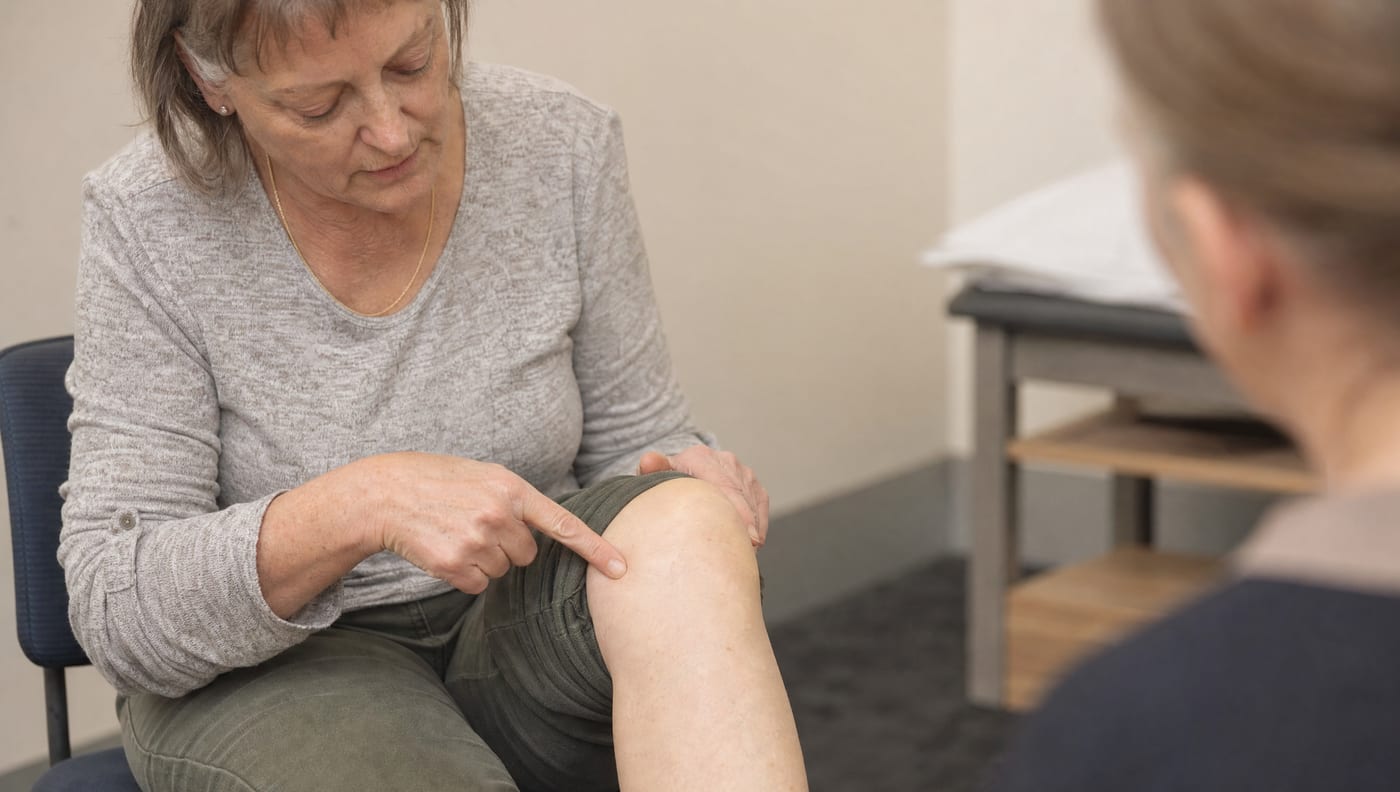
Start with the question that sorts most of it
At a review for a painful knee replacement the most useful question is not how bad is it. It is:
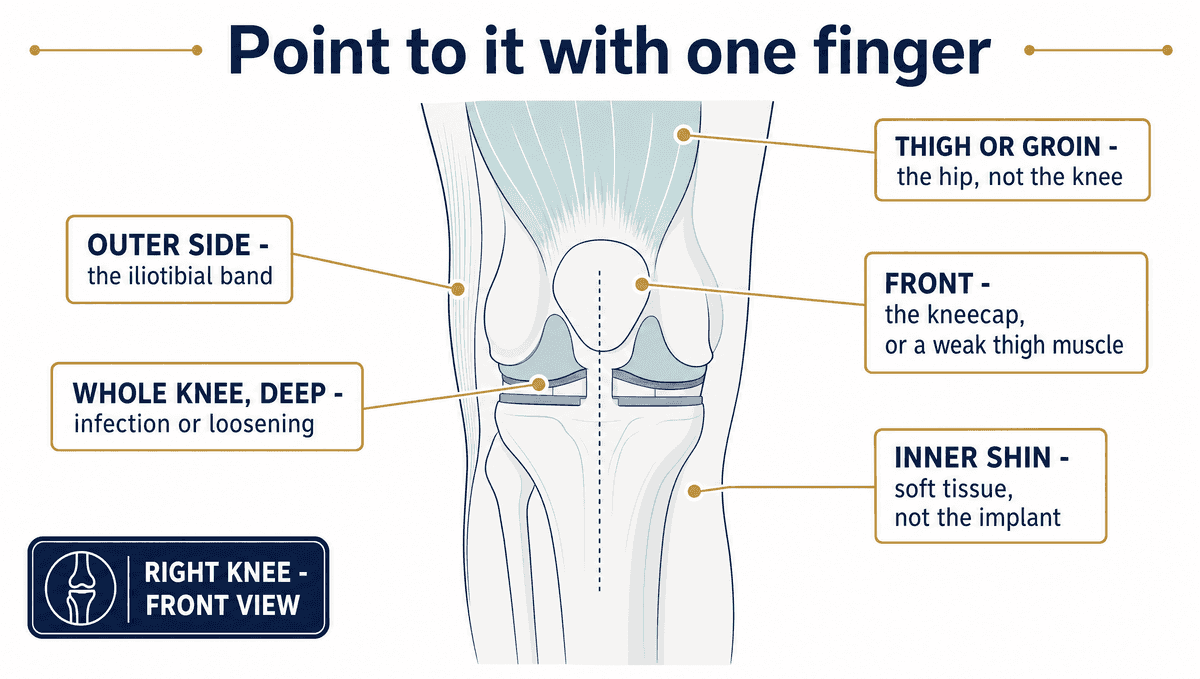
Point to it with one finger.
What happens next divides the field more effectively than any scan:
- A fingertip lands on one spot — usually soft tissue or nerve. Often treatable, rarely to do with the implant.
- A flat hand covers the whole knee — diffuse, deep pain. This is the pattern that raises infection, loosening and sensitised pain.
- The hand goes to the front, and the trouble is standing from a chair or going downstairs — the kneecap.
- The hand goes to the thigh or the groin — the hip, not the knee.
- The hand traces a line down the leg — the lower back.
Then: when is it worst? Pain that is worst with activity and settles with rest behaves mechanically. Pain that is worst at rest and at night behaves inflammatory, and that distinction genuinely changes what is looked for.
The causes, and how each declares itself
It is still early, and it is going to settle. The most common answer, and the one to exclude honestly rather than reach for by default. Recovery runs to about twelve months, and a knee that is slowly improving, swells after a long day and behaves better this month than last is on that track. Knee replacement recovery sets out what the ordinary course looks like.
Soft tissue around the joint. The tendons and bursae around a knee that has been rebuilt and then made to work differently are a common and under-recognised source of pain. Tenderness on the inner side of the shin a few centimetres below the joint (pes anserine), pain along the outer side that is worse walking downhill (iliotibial band), pain at the back of the thigh, or pain where the quadriceps or patellar tendon attaches. These are the classic one-finger pains. They respond to targeted physiotherapy, sometimes to a local injection, and almost never to further surgery.
The kneecap. Pain at the front, worst on stairs, standing from a low chair and after sitting for a while, sometimes with a sense of the knee giving way. Patellofemoral pain after a knee replacement can come from the tracking of the kneecap, from whether it was resurfaced, or simply from a weak quadriceps that lets it load badly. The last of those is much the most common and is treated with strength work rather than an operation.
Weakness mistaken for pain. A knee that aches, feels heavy and unreliable, and tires quickly is often reporting a quadriceps that never properly recovered rather than a problem inside the joint. It is one of the few causes on this list that is entirely reversible, and it is missed constantly. Bending and straightening after surgery covers how to tell the two apart.
Stiffness. A knee that has not regained movement hurts at the ends of the range it has, and the pain is a symptom of the stiffness rather than a separate problem. The management is the stiffness pathway, not the pain pathway.
Nerve pain. Burning, electrical, shooting or crawling sensations, a patch of skin that is painful to light touch, symptoms worse at rest and at night. These respond poorly to ordinary painkillers and well to medication aimed specifically at nerve pain — numbness, zaps and nerve pain deals with this in full.
Referred from the hip or the back. Arthritis of the hip refers to the front of the thigh and occasionally presents as knee pain alone. Lumbar nerve irritation can be felt below the knee and typically changes with sitting, bending or walking distance. Both are missed regularly, for the understandable reason that the patient and everyone else is looking at the knee that was just operated on.
Instability. A knee that gives way, that you do not trust on uneven ground or stairs, and that swells after it has misbehaved. Sometimes a soft tissue balance issue, sometimes weakness, occasionally a mechanical problem with the components.
Low-grade infection. The one that must be actively excluded rather than assumed against. It does not always present with fever and redness. The more typical late presentation is a knee that never became comfortable, or one that was comfortable and then changed — persistently painful, swollen, stiff, and worse at rest. Because it changes everything downstream, it is investigated early.
Loosening or wear. Usually later than a year, usually pain on weight bearing that eases with rest, often with a change in the knee’s behaviour rather than a gradual worsening. Visible on X-rays compared against the immediate post-operative films, which is why those earlier images matter.
Sensitised pain. In some people the nervous system itself becomes the driver: the pain outlasts the injury, spreads beyond the joint, and stops behaving mechanically. It is more likely where there was long-standing severe pain before surgery, pain elsewhere in the body, or significant sleep and mood disturbance during recovery. It is real, it is physiological, and it is treated quite differently — through a pain specialist, graded activity and medication aimed at the nervous system rather than the joint. Naming it is not a way of saying the pain is in your head.
What the assessment actually involves
In roughly this order, because each step narrows what the next needs to look at:
- The history. When it started, whether the knee was ever comfortable, what provokes it, whether it wakes you, whether anything has changed. A knee that was never right from day one points somewhere different from a knee that was fine for eight months and then changed.
- Examination. Of the knee, and also of the hip and the lower back, because two of the causes above are not in the knee at all.
- X-rays, including standing views, compared against the films taken immediately after surgery. Comparison is the point; a single current film answers much less.
- Blood tests — inflammatory markers, looking for infection.
- Aspiration of the joint where infection is a genuine possibility. Fluid drawn from the knee and sent for cell count and culture. It is the definitive test and it is worth the small unpleasantness.
- Further imaging where a specific question remains — a CT to assess component rotation, a bone scan or SPECT-CT to look for loosening, an MRI or ultrasound for soft tissue, or imaging of the hip or spine.
The sequence matters. Reaching for a scan before the history and examination have framed a question produces findings without answers, which is how people end up with several scans and no plan.
What can be done about each
- Soft tissue pain — targeted physiotherapy, load management, sometimes a local injection. Good results.
- Weakness — progressive strengthening, properly supervised and continued long enough. Slow, unglamorous, effective.
- Stiffness — the stiffness pathway, which depends heavily on how far out you are.
- Nerve pain — medication aimed at nerve pain, and time. Most settles.
- Referred pain — treat the hip or the back. The knee was never the problem.
- Infection — surgical treatment, the form of which depends on how long it has been present. Not something to manage with antibiotics alone.
- Loosening, instability or a mechanical problem — revision surgery, where a specific correctable problem has been identified.
- Sensitised pain — a pain specialist, graded activity, sleep, and medication aimed at the nervous system.
The thing to be careful about
Revision surgery for pain without a cause is the trap.
Where an identified problem exists — a loose component, infection, instability, a demonstrable mechanical issue — revision addresses it and is worth doing. Where the investigation has found nothing and the operation is offered anyway on the reasoning that something must be wrong, the results are considerably less predictable, and a proportion of patients are left worse than before.
This is why a thorough assessment before any discussion of further surgery is not caution or delay. It is the difference between an operation that fixes something and an operation that hopes to.
If you want another opinion
You are entitled to one, it does not require anybody’s permission, and it does not imply criticism of your surgeon. It is most useful when you bring the whole record:
- The operation report, and the implant details — brand, type and sizes
- The X-rays taken immediately after surgery, which matter as much as recent ones
- Any imaging since, including anything of the hip or back
- Blood test results
- A written account of the pain — where, when it started, what makes it worse, whether it ever settled
Second opinions covers how that appointment works, and knee revision surgery covers what it involves if it comes to that. Dr Clark completed a subspecialty fellowship in revision arthroplasty at The Royal Orthopaedic Hospital in Birmingham and sees painful and failed knee replacements referred from elsewhere, including knees he did not operate on.
What not to conclude
That you are being difficult. That you should have waited longer, or gone somewhere else, or not had it done. That because nothing showed on a scan there is nothing there.
A painful knee replacement is a problem with a differential diagnosis, and a differential diagnosis is something that can be worked through. The useful next step is almost always the same: get it properly assessed, with the old films in hand and a clear question.
Next: Knee revision surgery — or read about getting a second opinion.
Is it normal for a knee replacement to still hurt at six months?+
Some discomfort at six months is common and not in itself a sign that anything is wrong. What matters more than the presence of pain is its direction and character: pain that is gradually reducing, is worse after a big day and settles with rest, and does not wake you regularly, is ordinarily part of a recovery that runs to about twelve months. Pain that has plateaued or is increasing, that wakes you most nights, or that is sharply localised to one spot, is worth assessing rather than waiting out.
Why does my knee replacement still hurt a year later?+
There is a real group of patients whose knee remains painful a year after an entirely well-performed operation, and the most important thing to say is that this is a recognised outcome rather than a failure of effort. The causes divide roughly into soft tissue pain around the joint, pain referred from the hip or lower back, nerve-related pain, a low-grade infection, a mechanical problem with the implant, and pain sensitisation where the nervous system itself has become the driver. They are separated by history, examination and targeted investigations, and several of them have a specific treatment.
How do you tell whether it is the implant or something else?+
Largely by where the pain is and what provokes it. Pain you can cover with one fingertip is usually soft tissue or nerve rather than the implant. Pain that is deep, diffuse and present at rest, particularly with night pain and stiffness, raises the question of infection or loosening. Pain on the first few steps after sitting that settles as you walk points towards the kneecap. Pain in the thigh or groin rather than the knee raises the hip. Investigations — X-rays, inflammatory blood tests, sometimes aspiration of the joint or further imaging — then confirm or exclude what the history suggests.
Can a knee replacement get infected years later?+
Yes, though it is uncommon. Bacteria can reach a joint replacement through the bloodstream long after the operation, from a dental abscess, a skin infection or a urinary infection. The presentation is often less dramatic than people expect — a knee that was comfortable and has become persistently painful, swollen and stiff, sometimes without fever. Because infection changes the entire management, it is excluded early rather than late in the assessment of any painful knee replacement.
Will a revision operation fix a painful knee replacement?+
Only where there is an identified problem for the revision to correct — a loose component, a significant mechanical issue, instability, or infection. Revision surgery performed for pain alone, where no cause has been found, has considerably less predictable results and can leave a patient worse off. This is the single most important reason to complete the investigation before discussing another operation, and to be wary of anyone who offers revision before the cause is established.
Should I get a second opinion about a painful knee replacement?+
It is a reasonable thing to do and it does not imply criticism of anyone. A second opinion is most useful once you have a clear question — why this knee hurts, whether anything has been missed, and what the options are — and most useful when you bring the whole record with you, including the operation report, the implant details and every scan since. Bringing the pre-operative X-rays matters as much as the recent ones.
Does pain before the operation affect pain afterwards?+
There is a consistent relationship between how much pain a person has before a knee replacement, how long they have had it, and how likely they are to have ongoing pain afterwards — as there is with pain elsewhere in the body, poor sleep and low mood at the time of surgery. This is not a reason to defer an operation indefinitely, but it is a reason to address what can be addressed beforehand, and a reason for the conversation about expectations to happen before surgery rather than after.