
Robotic-Assisted Knee Replacement: What It Actually Means for You as a Patient
13 August 2026 · Updated 18 August 2026
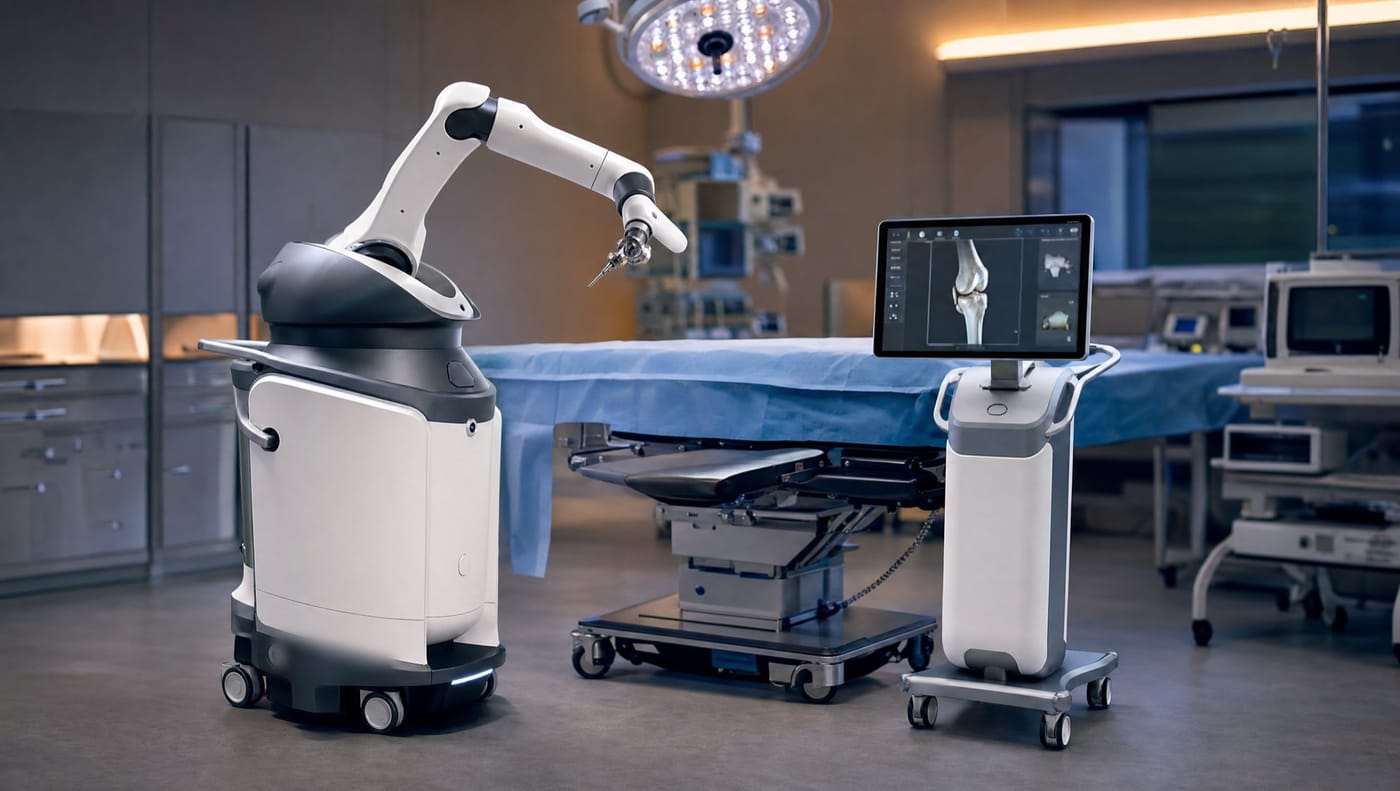
If you have been researching knee replacement lately, you have probably come across the word “robotic” more than once. It is easy to picture something out of science fiction — a machine making decisions on its own while you are asleep on the table.
That is not what happens. In a robotic-assisted knee replacement, the surgeon performs the operation and makes every decision. The robotic system carries out a plan the surgeon built beforehand, and provides real-time feedback so the implant goes exactly where it was planned. Understanding that distinction is the difference between being unsettled by the technology and being able to ask useful questions about it.
Robotic assistance has quickly become one of the most talked-about advances in orthopaedic surgery. In April 2026, a California health network announced a world record of 1,000 robotic-assisted knee replacements performed by a single surgeon, and Mayo Clinic has described the shift toward robotic and personalised techniques as the start of a new era for joint surgery. For patients, headlines like these tend to raise as many questions as they answer.
So here is what the technology actually does, and what it might mean for your own knee.
The robot doesn’t perform your surgery — your surgeon does
This is the point worth clearing up first. Robotic-assisted knee replacement is exactly that: assisted. Your surgeon is the one making every decision and every cut. The robotic system is a highly precise tool that helps carry out the surgical plan your surgeon has already mapped out — a bit like a GPS supports a driver who is still the one steering the car.
The system does not act independently, does not make clinical judgements, and is never left to its own devices. It holds the plan and helps execute it accurately.
How the planning works: a virtual pre-operation
Before your operation, imaging of your knee may be used to build a detailed three-dimensional model of the joint. On the Mako system, which Dr Clark uses, this means an additional CT scan taken specifically for planning. (He also uses VELYS, which builds its model in theatre instead and needs no scan.)
That model lets your surgeon plan implant size, positioning and alignment down to the millimetre, tailored to your own anatomy rather than a generic template. The operation is effectively rehearsed on a computer first — a virtual pre-operation — so the key decisions are made before any incision.
During surgery, the robotic arm or handheld device provides real-time feedback, helping your surgeon place the implant exactly where it was planned and fine-tune the balance of the surrounding soft tissue. If something in the knee turns out differently once the joint is opened, the plan can be adjusted then and there.
Why precision matters more than it sounds
It is tempting to think a knee replacement is a knee replacement. But small differences in alignment and implant fit have a real effect on how a new knee feels day to day.
A joint that is even slightly out of balance can lead to:
- Stiffness, or a knee that never quite feels like it settles
- An unnatural feeling through the gait
- Uneven loading, and faster wear over time
The appeal of robotic assistance is that it narrows the margin for error and allows a more personalised fit, accounting for your particular bone shape, ligament tension and range of motion. Surgeons who use these systems report that patients often experience more predictable alignment and a more natural-feeling knee.
What the evidence does and doesn’t show
It is worth being straight about this, because the marketing around robotics tends to run ahead of the data.
What is well established: robotic assistance improves the accuracy of implant positioning and limb alignment. Surgeons hit their intended targets more consistently, with fewer outliers.
What is still being measured: whether that accuracy means implants last longer. Answering that properly takes 15 to 20 years of follow-up, and the technology has not been in widespread use long enough. The Australian Orthopaedic Association National Joint Replacement Registry tracks every joint replacement performed in Australia and is monitoring robotic-assisted procedures specifically. Early signals are encouraging, but they are early.
As with any surgery, the result still depends heavily on the surgeon’s skill and experience, and on you — your general health, your commitment to rehabilitation, and the condition of the joint going in. Technology narrows the margin for error. It does not replace judgement, and it does not do your physiotherapy for you.
Is robotic-assisted knee replacement right for you?
If you are a suitable candidate for a conventional knee replacement, you are generally also a candidate for a robotic-assisted one. It is not reserved for particularly complex or unusual cases, though it can be especially useful where the anatomy is more challenging to work with — significant deformity, unusual bone shape, or a previous injury that has changed the alignment of the leg.
Robotic assistance is used for both total knee replacement and partial knee replacement. In a partial replacement, where only the damaged compartment of the knee is resurfaced, accurate positioning matters a great deal — there is less room for error when the rest of the joint is being preserved.
The right question to bring to your consultation is not “should I ask for the robot,” but “what approach do you recommend for my knee, and why?” A good surgeon will explain their reasoning, whether or not that includes robotic assistance, and will be honest with you about what to expect. Technology is one part of a good outcome. The experience and judgement of the person operating on your knee still matters most.
If you’re considering knee surgery in Perth
Dr Rhys Clark uses robotic assistance for both total and partial knee replacement, planned as a virtual pre-operation from a CT scan. He consults at St John of God Medical Clinic in Murdoch and in Mandurah, and operates at St John of God Murdoch, Sir Charles Gairdner Hospital and Perth Children’s Hospital.
For the detail — how the CT planning works, what the evidence supports, who it suits and what it costs — see robotic-assisted knee replacement.
If you are earlier in the process and still working out whether surgery is the right step, Understanding Knee Arthritis covers what arthritis is and what the non-surgical options look like. If cost is on your mind, what a knee replacement costs in Australia sets out the public, private and self-funded pathways — Dr Clark works on a no-gap basis for privately insured patients.
The takeaway
Robotic-assisted knee replacement is not about handing your surgery over to a machine. It is about giving your surgeon a more precise set of tools to plan and carry out an operation tailored specifically to your knee.
If you are weighing up your options, it is a reasonable thing to ask about at your next appointment — alongside all the other questions that matter just as much: your surgeon’s experience, your own health and goals, and what your recovery will realistically look like.
If you would like to talk through whether knee replacement, robotic-assisted or otherwise, is the right next step for you, book a consultation and we can discuss what suits your knee and your lifestyle.
This article is general information only and is not a substitute for personalised medical advice. Please speak with your surgeon about what is right for your individual circumstances.
Common questions
Does a robot perform the knee replacement? +
No. Robotic-assisted knee replacement is exactly that — assisted. The surgeon makes every decision and performs the operation. The robotic system holds the surgical plan the surgeon created beforehand and gives real-time feedback during the procedure, so the implant is placed where it was planned. It does not operate on its own and it is never left unsupervised.
Is robotic knee replacement better than conventional knee replacement? +
Robotic assistance reliably improves the accuracy of implant positioning and alignment — that much is well established. Whether that accuracy translates into implants lasting longer is still being measured, because the technology is newer than the 15 to 20 years of follow-up needed to answer the question. The Australian Orthopaedic Association National Joint Replacement Registry monitors robotic-assisted procedures for exactly this reason. Early results are encouraging rather than conclusive.
Am I a candidate for robotic-assisted knee replacement? +
If you are a suitable candidate for a conventional knee replacement, you are generally also a candidate for a robotic-assisted one. It is not reserved for complex or unusual cases, though it can be particularly useful where the anatomy is more challenging or there is significant deformity.
Do I need a CT scan before robotic knee replacement? +
It depends on the system. Dr Clark uses Mako, which is planned from an additional CT scan taken before surgery — the scan builds a three-dimensional model of your knee and the operation is rehearsed on a computer as a virtual pre-operation, so implant size and position are decided before any incision is made. He also uses VELYS, which is imageless and maps the knee in theatre instead, with no planning scan needed.
Is recovery faster after a robotic-assisted knee replacement? +
Recovery follows broadly the same path as a conventional knee replacement. Most patients bear weight within hours of surgery, go home within a few days, and use a walking stick or crutches for the first few weeks. Robotic assistance is about the accuracy of the implant placement, not a shortcut through rehabilitation — your effort in physiotherapy still does most of the work.
Does robotic-assisted knee replacement cost more in Australia? +
It should not change what you pay Dr Clark. He works on a no-gap basis for privately insured knee replacement patients, matching his fees to what the insurer pays, and robotic assistance is part of how he performs the operation rather than an added extra. Hospital and prosthesis costs depend on your pathway and your health fund.
Does Dr Rhys Clark use robotic assistance for knee replacement in Perth? +
Yes. Dr Clark uses robotic assistance for both total and partial knee replacement, with the Mako system (planned as a virtual pre-operation from a CT scan) or the imageless VELYS system. He consults at St John of God Medical Clinic in Murdoch and in Mandurah, and operates at St John of God Murdoch, Sir Charles Gairdner Hospital and Perth Children's Hospital.