
Could Changing the Way You Walk Ease Knee Arthritis Pain?
14 September 2026
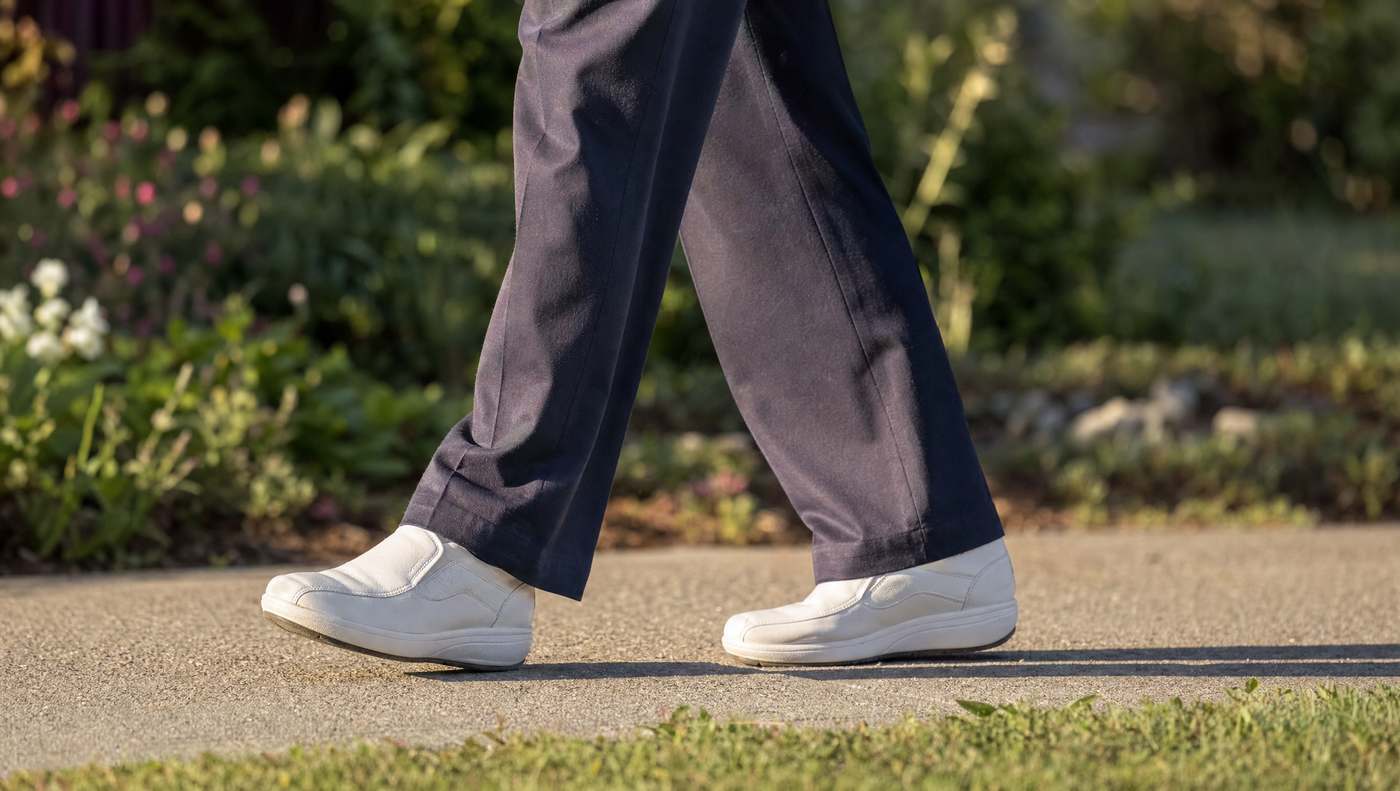
If you have knee arthritis, you have almost certainly been told to keep moving, lose a few kilos if there are a few to lose, and perhaps try a brace or different shoes. What you probably have not been told is that the angle your toes point when you walk may be making the pain worse — or that changing it by a few degrees might ease it.
That is the claim behind a trial published in The Lancet Rheumatology, and it is a more careful piece of work than most of what circulates about knee arthritis. It is worth understanding properly rather than filing under “another headline”.
What the trial actually did
The study ran at Stanford University’s Human Performance Laboratory and the Veterans Affairs Palo Alto Healthcare System, funded by the US Department of Veterans Affairs. Its lead author, Scott Uhlrich, is now at the University of Utah.
Everyone in it had symptomatic arthritis in the medial compartment — the inner side of the knee, which carries most of the load when you walk and is the most common place for wear to start. The arthritis had to be mild to moderate.
The recruitment funnel is worth pausing on, because it tells you how selected this group was. Around 1,582 people were screened. 107 got as far as a gait analysis. 68 were randomised. Mean age was 64.
Those 68 were split evenly:
- The retraining group were given a personalised target: a 5° or 10° change in foot angle, turning the toes in or out — whichever direction the motion capture showed took the most load off their knee.
- The sham group were coached, with identical equipment and identical attention, to walk at their own natural foot angle. Same routine, no actual change.
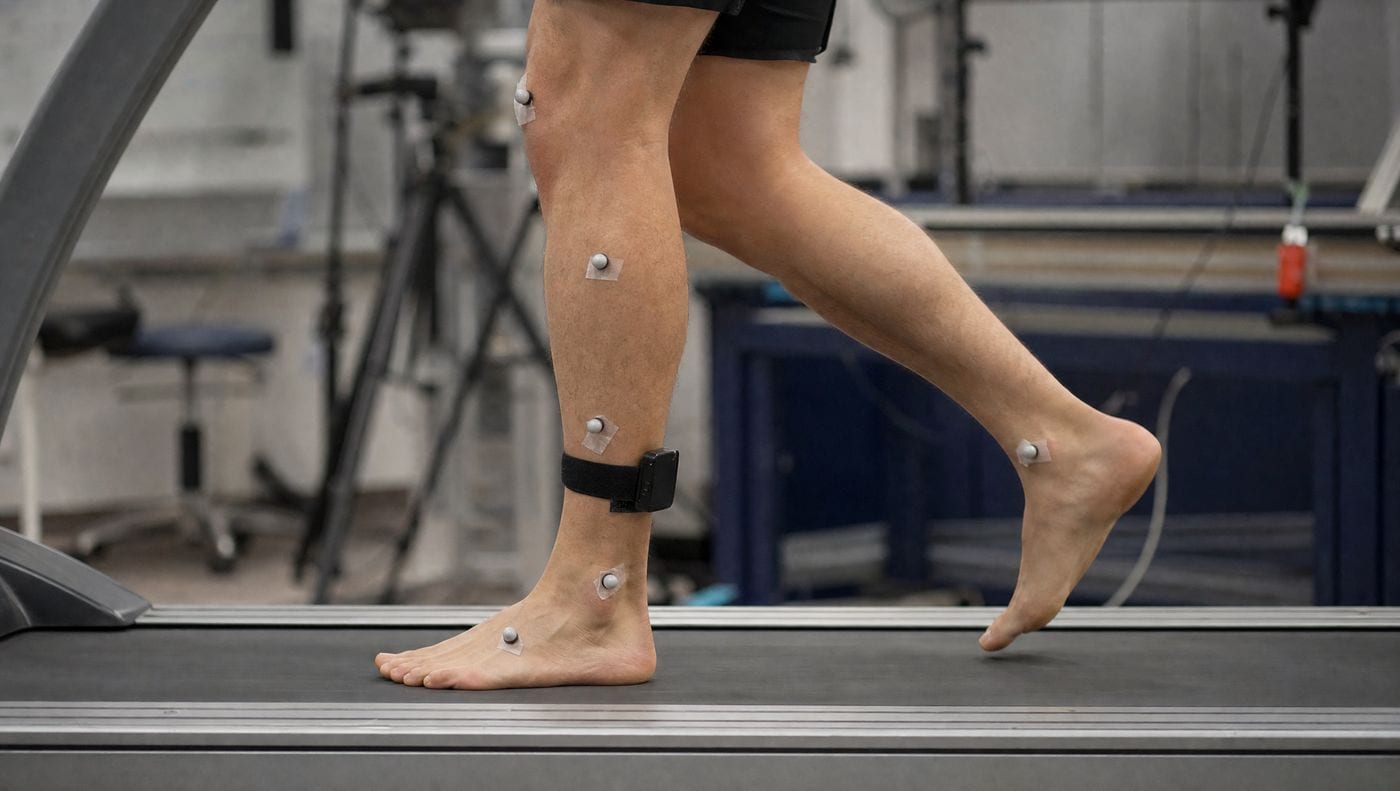
Both groups attended six retraining sessions, walking on a treadmill with a small device strapped to the shin that buzzed when they drifted off target, then kept practising at home for the rest of the year.
That sham design is the reason the trial is worth reading. Gait interventions have been tried before with muddy results, and one reason earlier attempts disappointed is that they handed every patient the same instruction. Turning the toes out helps some knees and actively hurts others. Working out the direction for each individual knee was the entire premise here.
What it found
Pain. After a year, the retraining group’s pain had fallen about 1.2 points further on a 0-to-10 scale than the sham group’s. That is the honest headline number — the difference between the groups, not the improvement within one of them.
It is also worth noticing that the sham group improved too, by a bit over a point. Six coaching sessions and a year of paying deliberate attention to your walking does something on its own. Any trial without that comparison would have reported a much more impressive result and told you much less.
Load. The measured peak load through the inner knee dropped further in the retraining group as well. So the pain change tracked a real mechanical change, which is what you want to see — it makes expectation a less likely explanation.
Cartilage. This is where honesty matters. The researchers imaged cartilage composition on MRI using two different techniques. One (T1-rho) favoured the retraining group, consistent with slower deterioration in the treated compartment. The other (T2) showed no difference at all. One of two measures moved. That is a real signal and an incomplete one, and twelve months is not long enough to claim the course of the arthritis was changed.
Safety. No severe adverse events. But two of the 34 people in the retraining group, and one of the 34 in the sham group, dropped out because their knee pain got worse. That happened with supervision, in a laboratory, with an individually prescribed angle. Keep it in mind for the section below.
Why a few degrees would matter at all
Turning your toes a few degrees sounds far too small to change anything. The biomechanics make sense once you see them.
Every time your foot hits the ground, force travels up through the leg and across the knee. Where that force lands inside the joint depends heavily on the position of the foot. In a knee with medial compartment arthritis, the inner side is already worn and more sensitive to load, so a small rotation that redistributes force toward healthier cartilage can reduce both the pain signal and, in principle, the ongoing wear.
That is a different mechanism from most arthritis treatment. Pain medication dulls the signal. This tries to reduce what is generating it.
It is also the same reasoning that sits behind surgery for the same problem. Medial compartment arthritis with a healthy remainder of the joint is precisely the pattern that suits a partial knee replacement, where one worn compartment is resurfaced and the rest of the knee is left alone. Different scale of intervention, same underlying idea about where load goes. If you are weighing those options, partial versus total knee replacement covers how that decision is actually made.
What the trial does not show
- One centre, 68 people. Respectable for this kind of study, still a single trial.
- One compartment, mild to moderate. It says nothing about knees with arthritis in two or three compartments, or advanced disease.
- One year. Nobody knows whether the benefit holds at three years or five.
- A highly selected group. 1,582 screened, 68 randomised. Your knee may simply not be the kind of knee this works on.
And the practical barrier: the personalised angle required a university gait laboratory with motion capture. That is expensive, and your physiotherapist does not have one in the corner.
The research team has started testing whether ordinary smartphone video, and instrumented footwear, could do the same job. If that works it changes everything about availability. It is not finished.
So can you actually do anything with this?
Not in the form the trial delivered it, and not by working it out yourself from a video.
That is not excessive caution. The whole point of the trial was that the correct direction differs between knees — turn the wrong way and you increase medial load rather than reducing it. Changing your gait also pushes load onto the other compartments of the knee, the hip, the ankle and the lower back. Three people in a supervised laboratory setting still ended up in more pain.
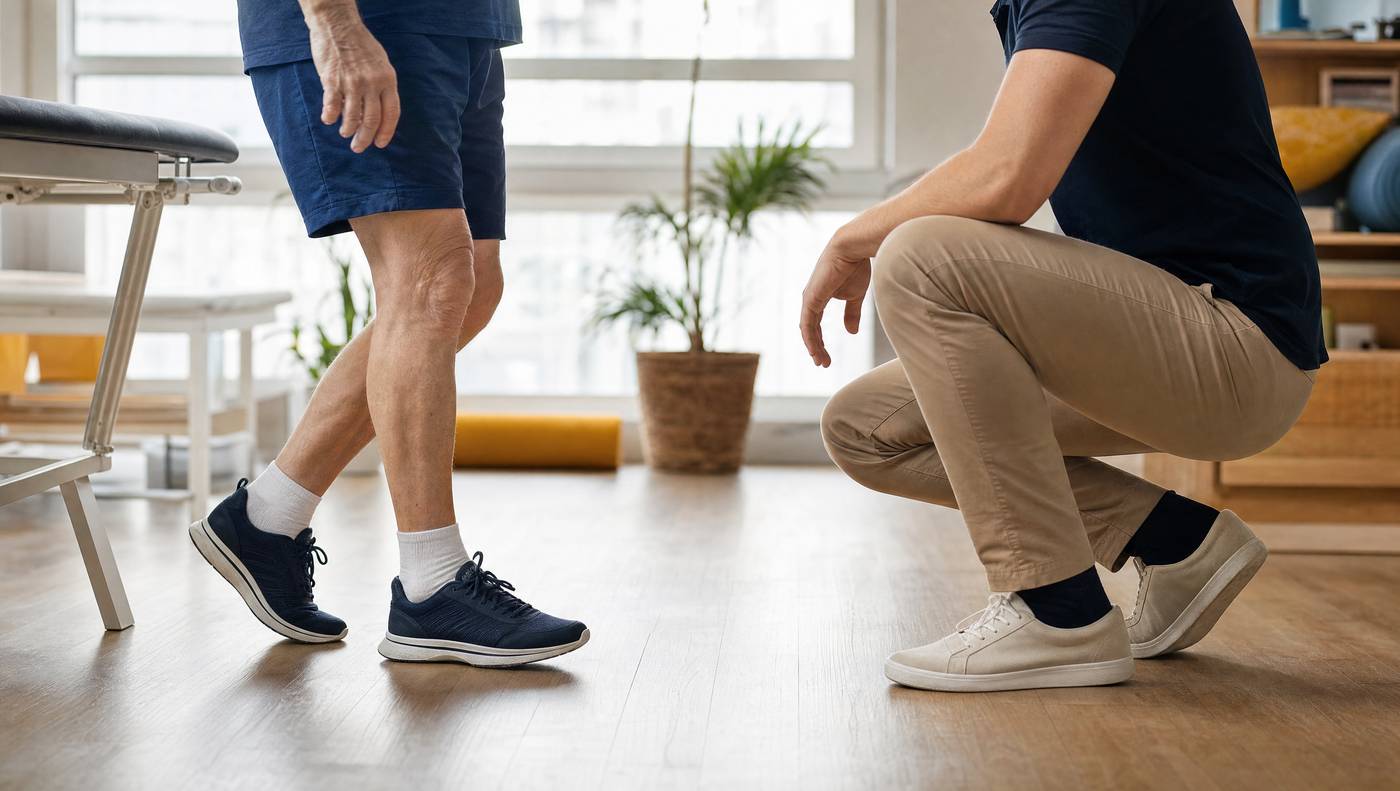
What is reasonable is to raise it with your physiotherapist as part of a wider conversation about load through the knee. Plenty of physiotherapists already look at how you walk without a laboratory attached, and it is a fair question to bring to your next appointment.
Alongside it, the things with much stronger evidence behind them remain the foundation:
- Exercise and physiotherapy — the only treatment the Australian guideline strongly recommends for everyone with knee osteoarthritis
- Weight and knee load — where 5 to 7.5% of body weight is the target that shows measurable benefit
- The rest of the non-surgical options, including what the guideline recommends against
Where this sits
A trial showing that a few degrees of foot angle can ease arthritis pain and reduce joint load is a good reminder that not every advance in this field is a new implant or a new drug. It is early, it is one study, and it is delivered in a way that is not yet practical outside a research laboratory.
It is also not a substitute for a knee replacement once a joint has genuinely worn out. Those are different stages of the same disease, and this trial was studying the earlier one. If you are trying to work out which stage you are at, do I need a knee replacement walks through the questions that actually settle it, and understanding knee arthritis covers what is happening in the joint.
For now, the most useful thing to do with this research is take it to your physiotherapist as a question — not to go looking for it as a treatment.
If you are managing knee arthritis and want to work out what will help your particular knee — whether that is protecting it for as long as possible, or knowing when it is time to talk about replacement — book a consultation and we can go through it properly.
Reference: Uhlrich SD, Mazzoli V, Silder A, et al. Personalised gait retraining for medial compartment knee osteoarthritis: a randomised controlled trial. The Lancet Rheumatology 2025; 7(10): e708–e718. doi.org/10.1016/S2665-9913(25)00151-1. Trial registration NCT02767570.
Common questions
Can changing the way you walk help knee arthritis? +
In one randomised trial, yes — modestly, and for a specific group. Researchers at Stanford University and the VA Palo Alto Healthcare System retrained people with mild-to-moderate arthritis in the inner (medial) compartment of the knee to walk with their toes turned in or out by 5 or 10 degrees, chosen individually for each knee. After a year, their pain had fallen about 1.2 points further on a 0-to-10 scale than a sham group who were coached to walk at their own natural foot angle. The results were published in The Lancet Rheumatology in August 2025. It is one trial of 68 people, not a settled treatment.
What is gait retraining for knee osteoarthritis? +
Gait retraining means deliberately changing how you walk in order to shift load away from the worn part of the knee. In the Stanford trial the change was to the foot progression angle — how far the toes point in or out relative to the direction of travel. Participants attended six sessions walking on a treadmill while a small device strapped to the shin buzzed to tell them when they had hit their target angle, then practised at home for the rest of the year. The angle was worked out individually using motion capture, because the direction that helps one knee can be the wrong direction for another.
How much did gait retraining reduce knee pain in the trial? +
The retraining group's pain fell about 1.2 points further on a 0-to-10 scale than the sham group's over one year. Both groups improved, which matters: the sham group also got six coaching sessions and a year of deliberate walking practice, and they improved by a bit over a point on their own. The measured load through the inner knee fell further in the retraining group as well, so the pain change tracked a real mechanical change rather than expectation alone.
Does gait retraining slow knee arthritis or regrow cartilage? +
It does not regrow cartilage. The trial measured cartilage composition on MRI using two different techniques, and the results were mixed — one measure (T1-rho) favoured the retraining group, suggesting slower deterioration in the treated compartment, while the other (T2) showed no difference between groups. That is a genuine but partial signal over twelve months, not proof that arthritis was halted. Longer follow-up would be needed to know whether it changes the course of the disease.
Can I change my own foot angle to help my knee arthritis? +
It is not a good idea to attempt without assessment. The angle used in the trial was personalised with motion capture, because turning the foot the wrong way increases load on the inner knee rather than reducing it. Deliberately altering your gait also shifts load onto the other compartments of the knee, the hip, the ankle and the lower back. Even under supervision in the trial, three participants withdrew because their knee pain increased. If the idea interests you, raise it with your physiotherapist rather than copying an exercise from a video.
Is gait retraining available in Perth? +
Not in the form the trial used. Prescribing the angle required a university gait laboratory with motion capture equipment, which is not part of routine physiotherapy or orthopaedic care in Perth or anywhere else. The research team is testing whether ordinary smartphone video and instrumented footwear could do the same job, which would make it far more widely available, but that work is not finished. What is available now is a physiotherapist who assesses how you walk as part of treating your knee, which many already do.
Does this mean I can avoid a knee replacement? +
It does not tell you that. The trial studied mild-to-moderate arthritis confined to one compartment of the knee, in people who were largely years away from considering surgery. It says nothing about knees with advanced or widespread arthritis, which is the situation in which knee replacement is usually discussed. The useful framing is that this is potentially another way to buy time earlier in the disease, alongside exercise and weight management — not an alternative once a joint has genuinely worn out. Dr Rhys Clark is a knee replacement surgeon in Perth, consulting at St John of God Medical Clinic in Murdoch and in Mandurah.